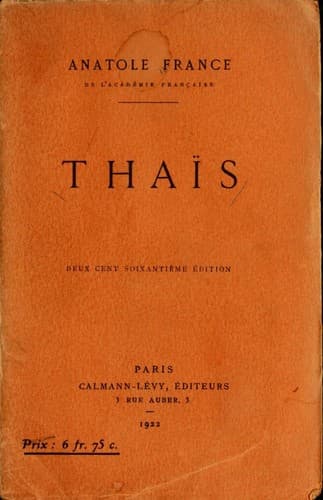
Christian women saints -- Fiction; Christianity, Conversion to -- Fiction; Courtesans -- Fiction; Egypt -- Fiction; Hermits -- Fiction
“Love me; yield, friend. As long as you resist me I shall torment you.
You do not know what the patience of a dead woman is. I shall wait, if
necessary, till you are dead. Being a sorceress, I shall put into your
lifeless body a spirit who will reanimate it, and who will not refuse me
what I have asked in vain of you. And think, Paphnutius, what a strange
situation when your blessed soul sees, from the height of heaven, its
own body given up to sin. God, who has promised to return you this body
after the day of judgment and the end of time, will Himself be much
puzzled. How can He place in celestial glory a human form inhabited by
a devil, and guarded by a sorceress? You have not thought of that
difficulty. Nor God either, perhaps. Between ourselves, He is not very
knowing. Any ordinary magician can easily deceive Him, and if He had not
His thunder, and the cataracts of heaven, the village urchins would pull
His beard. He has certainly not as much sense as the old serpent, His
adversary. He, indeed, is a wonderful artist. If I am so beautiful, it
is because he adorned me with all my attractions. It was he who taught
me how to braid my hair, and to make for myself rosy fingers with agate
nails. You have misunderstood him. When you came to live in this tomb,
you drove out with your feet the serpents which were here, without
troubling yourself to know whether they were of his family, and you
crushed their eggs. I am afraid, my poor friend, you will have a
troublesome business on your hands. You were warned, however, that he
was a musician and a lover. What have you done? You have quarrelled with
science and beauty. You are altogether miserable, and Iaveh does not
come to your help. It is not probable that he will come. Being as
great as all things, he cannot move for want of space, and if, by an
impossibility, he made the least movement, all creation would be pushed
out of place. My handsome hermit, give me a kiss.”
Paphnutius was aware that great prodigies are performed by magic arts.
He thought--not without much uneasiness--
“Perhaps the dead man buried at my feet knows the words written in that
mysterious book which exists hidden, not far from here, at the bottom of
a royal tomb. By virtue of these words, the dead, taking the form which
they had upon earth, see the light of the sun and the smiles of women.”
His chief fear was that the girl with the theorbo and the dead man might
come together, as they did in their lifetime, and that he should see
them unite. Sometimes he thought he heard the sound of kissing.
He was troubled in his mind, and now, in the absence of God he feared
to think as much as to feel. One evening, when he was kneeling prostrate
according to his custom, an unknown voice said to him--
Public-domain text, read in full here on John Shaqi.
Reviews
Reviews
No reviews yet
Be the first to share your thoughts on this work.
Elsewhere in the archive
Join the Discussion
Join the discussion
Sign in to leave a comment or review.
Sign InorCreate an account