He then went on to show me that the domestic cook, always appealing to
the small public of the family, gets narrowed in his views and bounded
in his resources. He compared them, I remember, to the writers in
certain religious newspapers, who must always go on spicing higher and
higher as the palates of their clients grow more jaded. How he worked
out his theme afterwards I cannot tell, for I was watching the windows
of the house, and stealing glances down the alleys in the garden,
longing for one look, ever so fleeting, of my lovely partner of the
night before.
“I see, young gentleman,” said he, evidently nettled at my inattention,
“your thoughts are not with me.”
“How long have we to stay, sir?” said I, reverting to the respect I
tendered him at my lessons.
“You have thirty-eight minutes,” said he, examining his watch: “which I
purpose to apportion in this wise,--eight for the douceur, five for the
cheese, fifteen for the dessert, five for coffee and a glass of curaçoa.
The bill and our parting compliments will take the rest, giving us three
minutes to walk across to the station.”
These sort of pedantries were a passion with him, and I did not
interpose a word as he spoke.
“What a pineapple!” cried a young fellow from an adjoining table, as
a waiter deposited a magnificent pine in the midst of the bouquet that
adorned our table.
“Monsieur Delorme begs to say, sir, this has just arrived from Laeken.”
“Don't you know who that is?” said a companion, in a low voice; but my
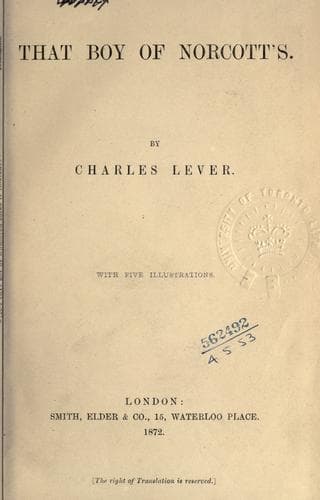
hearing, ever acute, caught the words, “He's that boy of Norcott's.”
I started as if I had received a blow. It was time to resent these
insolences, and make an end of them forever.
“You heard what that man yonder has called me?” said I to Eccles.
“No; I was not minding him.”
“The old impertinence,--'That boy of Norcott's.'”
I arose, and took the cane I had laid against a chair. What I was about
to do I knew not. I felt I should launch some insolent provocation. As
for what should follow, the event might decide _that_.
“I'd not mind him, Digby,” said Eccles, carelessly, as he lit his
cigarette, and stretched his legs on a vacant chair. I took no notice
of his words, but walked on. Before, however, I had made three steps
my eyes caught the flutter of a dress at the end of the alley. It was
merely the last folds of some floating muslin, but it was enough to rout
all other thoughts from my head, and I flew down the walk with lightning
speed. I was right; it was Pauline. In an instant I was beside her.
“Dearest, darling Pauline,” I cried, seizing her round the waist and
kissing her cheek, before she well knew, “how happy it makes me to see
you even for a few seconds.”
“Ah, milord, I did not expect to see you here,” said she, half
distantly.
“I am not milord; I am your own Digby--Digby Nor-cott, who loves you,
and will make you his wife.”
“Ma foi! children don't marry,--at least demoiselles don't marry them,”
said she, with a saucy laugh.
Public-domain text, read in full here on John Shaqi.
Reviews
Reviews
No reviews yet
Be the first to share your thoughts on this work.
Join the Discussion
Join the discussion
Sign in to leave a comment or review.
Sign InorCreate an account