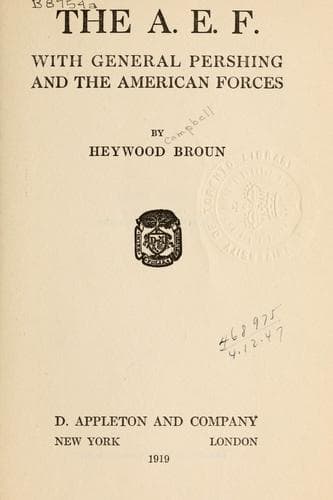
The A. E. F.: With General Pershing and the American ForcesBroun, Heywood
History
The A. E. F.: With General Pershing and the American Forces
Broun, Heywood
United States. Army. American Expeditionary Forces; World War, 1914-1918 -- Personal narratives
"There was always champagne at mess and they kept the graphophone
playing all through dinner any night a man from our squadron didn't come
back," an aviator said to me. "One afternoon we lost two men and before
dinner they took a leaf out of the table. Our commander didn't want us
to notice any empty seats or the extra space."
It is difficult to say which nation has the most daring aviators, but
that honor probably belongs to the English. I asked a Frenchman about it
and he said: "The English do most of the things you would call stunts.
There was one, for instance, that made a landing on a German aviation
field and after firing a few rounds at the aerodrome flew away again.
That was a stunt. But we think the English are fools with their
sportsmanship and all that. It doesn't work now. We look at it a little
differently. We cannot take fool chances. If you take a fool chance you
are very likely to get killed. That is not nice, of course. We do not
like to be killed, but more than that, it is one less man for France. We
must wait until there is a fair show."
"And when is that?" I asked.
"When there are not more than four Germans against you," said the
careful Frenchman.
The warlike spirit of the French aviators extended even to the servants
at the preliminary school which we visited. The Americans there were all
quartered in one big room and their general man of all work was a little
Annamite from French-Indo-China. Hy seemed the most peaceful member of a
peace-loving race as he moved about the barracks just before dawn every
morning waking up the students with a smiling "Bon jour" and an equally
good-natured "Café." One day he had a holiday and after borrowing a
uniform he went to a photographer's in the nearest town. From the
photographer he borrowed a rifle, a cutlass and a pistol. He thrust the
cutlass into his belt and shouldered the other two weapons. After he had
assumed a fighting face the picture was taken.
The next day Hy varied the routine. He began with "Bon jour" as usual,
but before he said "Café" he drew from behind his back the photograph,
and pointing to it proudly, exclaimed, "brave soldat."
We went from the French school to the big field where the American camp
was under construction. The bulk of the work was being done by German
prisoners. One of these, a sergeant, had been a well known architect in
Munich. The American workers consulted him now and then in regard to
some building problem and he always gave them good advice. He took
almost a professional pride in the growing buildings even if they were
designed to house the men who will one day be the eyes of the American
army. We asked another prisoner how he got along with the Americans and
he replied: "Oh, some of them aren't half bad." A third spoke to us in
meager broken English, although he said that he had lived five years in
Buffalo. "Are you going back to Germany after the war?" we asked him.
"Nein," he replied decisively, "Chicago."
Public-domain text, read in full here on John Shaqi.
Reviews
Reviews
No reviews yet
Be the first to share your thoughts on this work.
Join the Discussion
Join the discussion
Sign in to leave a comment or review.
Sign InorCreate an account