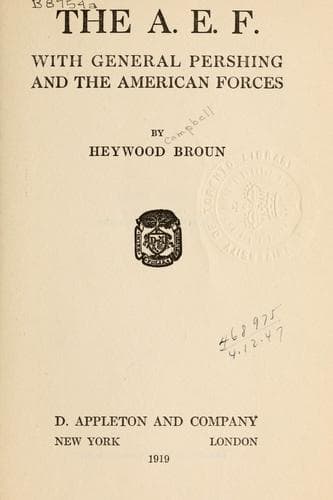
The A. E. F.: With General Pershing and the American Forces — John Shaqi
The A. E. F.: With General Pershing and the American ForcesBroun, Heywood
History
The A. E. F.: With General Pershing and the American Forces
Broun, Heywood
United States. Army. American Expeditionary Forces; World War, 1914-1918 -- Personal narratives
Most prisoners professed to be confident that Germany would win the war
and they all based their faith on the submarine. As we started to go the
man from Buffalo suddenly held out his hand and said: "So long." Several
of the correspondents shook hands with him much to the horror of a young
American in the French flying corps who accompanied us.
"You mustn't do that," he explained. "Any Frenchman who saw you do that
would be very much shocked."
I remembered then that when I saw German prisoners in any of the large
towns the French inhabitants took great pains to ignore them. I never
heard French people jeer at their prisoners. Their attitude was one of
complete aloofness. Once I saw prisoners in a big railroad station and
the crowds swept by on either side without a glance as if these men from
Prussia had been so many trunks or trucks or benches.
If the young Americans at the school had not been so busy learning the
business of flying they could have formed a cracker jack nine or eight
or eleven, as the squad included some of the most famous of our college
athletes.
We also visited an English aerodrome which was not far from our
headquarters. This was a camp from which planes started for raids into
Germany. The men who were carrying on this work were all youngsters. I
saw no one who seemed to be more than twenty-five. Just the day before
we arrived the Germans had discovered their whereabouts and had raided
the hangars. One man had been killed and two planes wrecked. Machine gun
bullets had left holes in all the buildings about the place. The English
officer smiled when we looked about. "Oh, yes," he said, "the Hun was
over last night and gave us a bit of a bounce." His slang was fluent but
puzzling. He was explaining why he and his fellow aviators flew at a
certain height on raids. "You see," he said, "the Hun can't get his hate
up as far as that."
The bombing machines of the squadron were huge, powerful planes, but
they all had pet names painted upon them such as "Bessie" and "Baby" and
"Winifred" which had been twice to Stuttgart. These English fliers were
a quiet, reticent crowd who became fearfully embarrassed if anybody
tried to draw them out on the subject of their exploits. One of them
went over to an American Red Cross hospital nearby a few days after our
visit and played bridge with three American doctors there. He had been a
rather frequent visitor and a keen and eager player, so they were
somewhat surprised when he told them at nine o'clock that he would have
to go. He was three francs behind and started to fumble around in his
pockets to find the change. "Oh, never mind," said one of the doctors.
"Some other night will do. You'll be over here again pretty soon, I
hope."
"Oh, no," said the young Englishman, "I'd rather pay up now. Sorry to
toddle off so early. Beastly nuisance, you know, but I've got to go over
and bomb Metz to-night."
Public-domain text, read in full here on John Shaqi.
Reviews
Reviews
No reviews yet
Be the first to share your thoughts on this work.
Join the Discussion
Join the discussion
Sign in to leave a comment or review.
Sign InorCreate an account