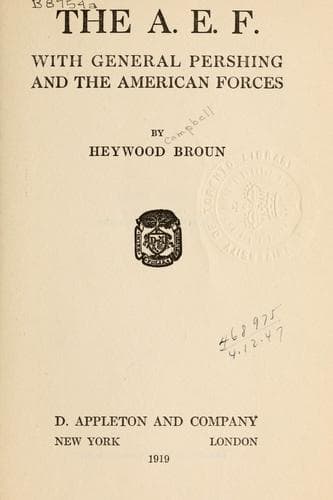
The A. E. F.: With General Pershing and the American Forces — John Shaqi
The A. E. F.: With General Pershing and the American ForcesBroun, Heywood
History
The A. E. F.: With General Pershing and the American Forces
Broun, Heywood
United States. Army. American Expeditionary Forces; World War, 1914-1918 -- Personal narratives
Much more would be heard of the flying exploits of the English if their
individual reticence were not combined with a governmental policy of not
announcing the names of the fliers who bring down enemy planes.
Unfortunately, the American army seems prepared to follow this example.
One of the high officers in the American air service in France said that
he did not intend to treat aviators like prima donnas. He added that he
thought it was a big mistake to advertise aces. However, the Germans
play up their star airmen in the newspapers and on the moving picture
screen and it must be admitted that they have not made many mistakes
from a purely military point of view.
Inevitably, however, the status of the flier is changing. Nobody regrets
this more than the aviators of France. The French army used to have a
saying, "all aviators are a little crazy," and nobody believed it so
thoroughly as the aviators. They took great pride in being unlike other
people in a war which was all cramped up into schedule. An aviator got
up when he felt like it and flew when the mood was on. If he felt
depressed, or unlucky, or out of sorts, he rolled over and went to sleep
again. Nobody said anything about it. When he fought the battle was a
duel with an opponent who was also a knight and sportsman although a
Boche.
But there was no keeping efficiency out of the air. The German brought
it there. He discovered that two planes were better than one and three
even better. He introduced teamwork and the lone French errants of the
air began to be picked off by groups of Germans who would send one
machine after another diving down on a single foe. The Flying Circus and
other aerial teams of the Germans have not only driven chivalry from the
air, but they have taken a good deal of the joy out of flying. Very
reluctantly the French have adopted squadron flying and the airman now
finds himself obeying commands just as if he were an infantryman or an
artillerist. Even the civilian population has begun to show that it
realized the change in the status of the aviator. There was, for
instance, poor Navarre, the finest flier in the army, who was sent to
prison because he came to Paris on a spree and ran down three gendarmes
with his racing auto. French aviators cannot see the sense of punishing
Navarre. I only heard one aviator who had any excuse to offer for the
civilian authorities.
"After all," he said, "they showed a little judgment. They did not
arrest Navarre until he had run down three gendarmes."
Public-domain text, read in full here on John Shaqi.
Reviews
Reviews
No reviews yet
Be the first to share your thoughts on this work.
Join the Discussion
Join the discussion
Sign in to leave a comment or review.
Sign InorCreate an account