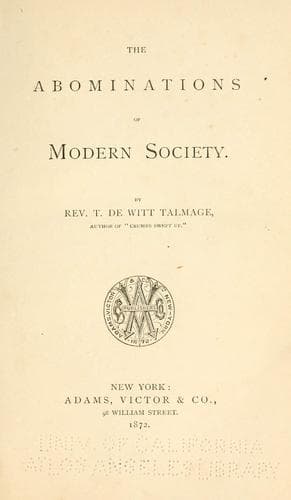
The Abominations of Modern SocietyTalmage, T. De Witt (Thomas De Witt)
Religion
The Abominations of Modern Society
Talmage, T. De Witt (Thomas De Witt)
Conduct of life
While among my readers are those who have passed on into the afternoon
of life, and the shadows are lengthening, and the sky crimsons with
the glow of the setting sun, a large number of them are in early life,
and the morning is coming down out of the clear sky upon them, and the
bright air is redolent with spring blossoms, and the stream of life,
gleaming and glancing, rushes on between flowery banks, making music
as it goes. Some of you are engaged in mercantile establishments, as
clerks and book-keepers; and your whole life is to be passed in the
exciting world of traffic. The sound of busy life stirs you as the
drum stirs the fiery war-horse. Others are in the mechanical arts, to
hammer and chisel your way through life; and success awaits you.
Some are preparing for professional life, and grand opportunities are
before you; nay, some of you already have buckled on the armor.
But, whatever your age or calling, the subject of gambling, about
which I speak in this chapter, is pertinent.
Some years ago, when an association for the suppression of gambling
was organized, an agent of the association came to a prominent citizen
and asked him to patronize the society. He said, "No, I can have no
interest in such an organization. I am in no wise affected by that
evil."
At that very time his son, who was his partner in business, was one of
the heaviest players in "Herne's" famous gaming establishment. Another
refused his patronage on the same ground, not knowing that his first
book-keeper, though receiving a salary of only a thousand dollars, was
losing from fifty to one hundred dollars per night. The president of
a railroad company refused to patronize the institution, saying--"That
society is good for the defence of merchants, but we railroad people
are not injured by this evil;" not knowing that, at that very time,
two of his conductors were spending three nights of each week at faro
tables in New York. Directly or indirectly, this evil strikes at the
whole world.
Gambling is the risking of something more or less valuable in the hope
of winning more than you hazard. The instruments of gaming may differ,
but the principle is the same. The shuffling and dealing of cards,
however full of temptation, is not gambling, unless stakes are put up;
while, on the other hand, gambling may be carried on without cards, or
dice, or billiards, or a ten-pin alley. The man who bets on horses,
on elections, on battles--the man who deals in "fancy" stocks,
or conducts a business which extra hazards capital, or goes into
transactions without foundation, but dependent upon what men call
"luck," is a gambler.
Public-domain text, read in full here on John Shaqi.
Reviews
Reviews
No reviews yet
Be the first to share your thoughts on this work.
Join the Discussion
Join the discussion
Sign in to leave a comment or review.
Sign InorCreate an account