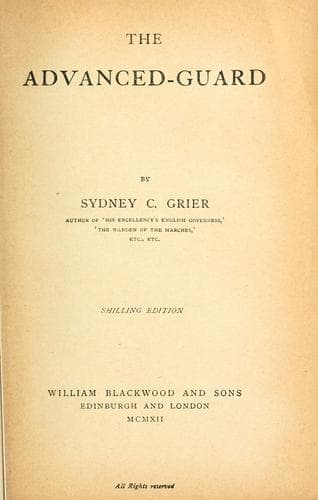
British -- Asia -- Fiction; Man-woman relationships -- Fiction; Soldiers -- Fiction
“You here?” she cried. “Why, an orderly came up ten minutes ago to ask
if you had come back, and I said you hadn’t. That old wretch Gobind
Chand, the Nalapur Vizier, is to come here to-morrow instead of next
week, and every one is as busy as possible. And you have been making
Penelope cry! Well, I hope Major Keeling will give you the worst
scolding you ever had in your life--for being so late, I mean, of
course.”
CHAPTER VI.
MOUNTING IN HOT HASTE.
Gobind Chand, to whom Lady Haigh had alluded, was the Hindu Vizier
of the Mohammedan state of Nalapur, the boundary of which marched with
that of Khemistan on the north. It was no secret to the rulers of
Khemistan that the consolidation of their power, of which Major
Keeling’s settlement on the frontier was only one of the signs, could
not be particularly welcome to the Amir Wilayat Ali. Formerly the
country beyond his own border had been a happy hunting-ground, whither
he could despatch any inconvenient Sardar or too successful soldier to
raid and plunder until he was tired, reserving to himself the right of
demanding a percentage of the spoil when the exile wished to return
home. There were also pleasant little pickings derivable from the
passage of caravans through the Akrab Pass, and the payment by weak
tribes or unwarlike villages of what one side called tribute and the
other blackmail, as the price of peace. These things gave the Amir a
distinct pecuniary interest in the frontier district, and during Major
Keeling’s first sojourn on the border, every effort had been made by
the Nalapuris, short of actual war, to convince him that his presence
was both undesired and useless. The lapse of time, however, and the
activity of the Khemistan Horse, proved to the Amir that his unwelcome
neighbour had come to stay, and whereas at first any raider had only
to cross the border to receive asylum, Wilayat Ali now persisted in
regarding the regiment as his private police. It was quite unnecessary
for him to take any trouble to secure marauders when the Khemistan
Horse had merely to come and seize them, and would do so whether he
liked it or not, and he announced that he left the task of keeping
order on both sides of the frontier to them, though this was not at
all Major Keeling’s intention, which had been to secure the Amir’s
active co-operation for the good of both states. To the English the
ruler posed as an obliging friend, but when he wished to demand
support or subsidies from his Sardars, he became a helpless victim
coerced by superior force; and as he could play both parts without
disturbing his own tranquillity by taking any steps whatever, he
opposed a passive resistance to all projects of reform. Major Keeling
had visions of a time when he would have leisure to arrange a
conference at which various outstanding questions might be discussed,
and the Amir brought to see what was expected of him; but in view of
the Amir’s obvious preference for the present state of things, there
Public-domain text, read in full here on John Shaqi.
Reviews
Reviews
No reviews yet
Be the first to share your thoughts on this work.
Join the Discussion
Join the discussion
Sign in to leave a comment or review.
Sign InorCreate an account