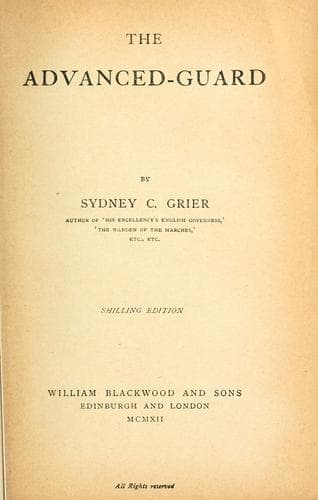
British -- Asia -- Fiction; Man-woman relationships -- Fiction; Soldiers -- Fiction
“Your promise,” he repeated. “I know you took advantage of his
generosity to withdraw it for a moment, but you renewed it again
immediately when I pointed out to you what you had done. Penelope, is
it possible that you--my sister--wish to break a solemn promise? What
reason can you possibly have for such a thing?”
Penelope writhed. She had no reason to give, even to herself. All she
knew was that she had felt to-day as never before the incubus of
George Ferrers’ presence, the utter lack of sympathy between herself
and him. If she contrasted him with any one else, it was done
unconsciously.
“I don’t believe he wishes it himself,” she said. “He doesn’t care for
me. He doesn’t behave as if he did.”
“He told me himself,” returned Colin’s solemn, accusing voice, “that
while he would not venture to appeal to you at present, it was his
dearest hope to claim your promise some day. It is your privilege to
help him to raise himself again to the position he has lost. What can
be a more noble task for a woman?”
Penelope could not say. Alone with Lady Haigh, it was easy to agree
that woman was an independent being, with a life and rights of her
own; but she would never have dreamt of asserting this to Colin, to
whom a woman was a more or less necessary complement to a man. Ferrers
needed her, therefore she would naturally accept the charge--that was
his view.
“Would you wish me to marry him as he is now?” she asked desperately.
“No,” he answered, after a moment’s consideration: “I am not quite
happy about him, and that is why I am most anxious you should be kind
to him. With your sympathy to help him on, and the hope of claiming
you at last, he will find the path much easier to climb. Surely this
is not too much to ask?”
It sounded eminently fair and reasonable, but Penelope felt that it
was not. There was a flaw somewhere which Colin did not see, and she
could not point out to him, even if she could be sure that she saw it
herself. Ferrers did not care for her, she was convinced, even in the
careless, patronising style of his early days, and yet he insisted on
keeping her bound. But perhaps he loved her in some strange fashion of
his own, of which she could have no experience or conception. And
Colin thought that the sacrifice was called for. She turned to him.
“I--I will try to like him, and help him--and do as he wishes,” she
said, finding a strange difficulty in speaking.
“Of course. I knew you couldn’t do anything else,” said Colin, with
such utter unconsciousness of the mental struggle she had just gone
through that Penelope found his calm acquiescence almost maddening.
She was glad to be saved the necessity of answering by the sudden
entrance of Lady Haigh, who turned back to rebuke a servant for not
having drawn up the blinds, and then discovered Colin.
Public-domain text, read in full here on John Shaqi.
Reviews
Reviews
No reviews yet
Be the first to share your thoughts on this work.
Join the Discussion
Join the discussion
Sign in to leave a comment or review.
Sign InorCreate an account