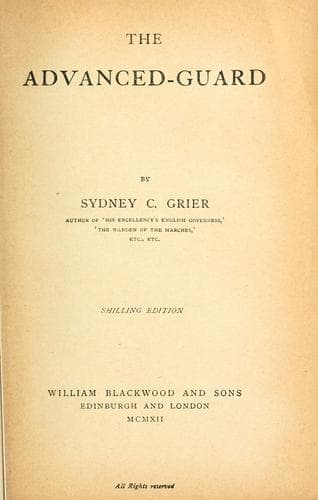
British -- Asia -- Fiction; Man-woman relationships -- Fiction; Soldiers -- Fiction
Penelope smiled feebly. She was very long in recovering from her
attack of fever, and Lady Haigh was anxious about her, even throwing
out hints as to the possibility of emulating the despicable conduct of
the Punjab ladies, and taking a trip to the Hills or the sea. But
Penelope only shook her head, and said she should be better when the
cool weather came. No change of scene could alter the fact that she
had finally and deliberately taken upon herself the responsibility of
Ferrers and his failings, or relieve her from the haunting feeling
that henceforward there would be a blank in her life. What caused the
blank she had not courage to ask herself. People were not so fond of
analysing their sensations in those days as in these; it was enough to
be conscious of an ever-present sense of loss, to know that she had
put away from her something that it would have been a joy to possess.
Three days passed without news of any kind, dreary days to the two
ladies, who devoted themselves, as in honour bound, to their
unsatisfactory pursuits, and only emerged from the fort for their
evening ride. The “gardens”--for the name which sounded ironical had
by general consent been adopted as prophetic--boasted a nondescript
erection of masonry which did duty as a band-stand; and here a band in
process of making struggled painfully through various easy exercises
and a mutilated edition of “God Save the Queen.” Lady Haigh and
Penelope always halted their _palkis_ dutifully in the neighbourhood
of the band, and stepped out to walk and talk a little with Major
Keeling and the other men. It was as necessary to appear here once
a-day as on the sea-drive at Bab-us-Sahel, and if Major Keeling was in
the town he never failed to show himself. Riding, fighting, building,
surveying, planting, exercising his men, administering his district,
he had ten men’s work in hand, and his only moment of leisure in the
whole day was this brief evening promenade. Lady Haigh told him once
that it was very good of him to devote it to social purposes. He
replied gravely that it was his duty, the least he could do--then
hesitated, and confessed that he did not dislike it, nay, that the
thought of it sometimes occurred to him pleasantly in the intervals of
his day’s labours, and Lady Haigh received the information with
suitable surprise and gratitude.
When the watchman on the fort tower announced at last that Sir
Dugald’s detachment was in sight, Major Keeling broke up abruptly the
court he was holding, and rode out to meet him. As soon as details
could be discerned through the haze of sand, he assured himself that
the numbers were complete, and that no fighting had taken place; but
Sir Dugald’s face, as he met him, did not bear any look of triumph.
“Well?” asked the older man sharply.
Public-domain text, read in full here on John Shaqi.
Reviews
Reviews
No reviews yet
Be the first to share your thoughts on this work.
Join the Discussion
Join the discussion
Sign in to leave a comment or review.
Sign InorCreate an account