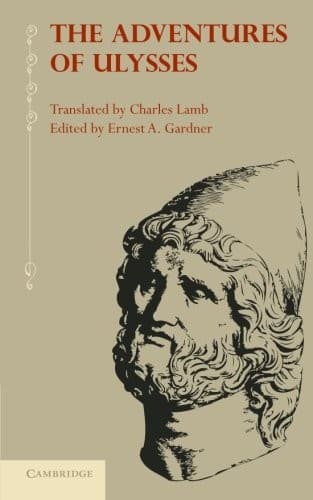
Homer. Odyssey -- Adaptations; Odysseus, King of Ithaca (Mythological character) -- Juvenile literature
Now Ulysses had not seen his wife Penelope in all the time since his
return; for the queen did not care to mingle with the suitors at their
banquets, but, as became one that had been Ulysses's wife, kept much in
private, spinning and doing her excellent housewiferies among her maids in
the remote apartments of the palace. Only upon solemn days she would come
down and show herself to the suitors. And Ulysses was filled with a
longing desire to see his wife again, whom for twenty years he had not
beheld, and he softly stole through the known passages of his beautiful
house, till he came where the maids were lighting the queen through a
stately gallery that led to the chamber where she slept. And when the
maids saw Ulysses, they said, "It is the beggar who came to the court
to-day, about whom all that uproar was stirred up in the hall: what does he
here?" But Penelope gave commandment that he should be brought before her,
for she said, "It may be that he has travelled, and has heard something
concerning Ulysses."
[Illustration: _Where the maids were lighting the queen through a stately
gallery_.]
Then was Ulysses right glad to hear himself named by his queen, to find
himself in nowise forgotten, nor her great love towards him decayed in all
that time that he had been away And he stood before his queen, and she
knew him not to be Ulysses, but supposed that he had been some poor
traveller. And she asked him of what country he was.
He told her (as he had before told Eumaeus) that he was a Cretan born,
and, however poor and cast down he now seemed, no less a man than brother
to Idomeneus, who was grandson to king Minos; and though he now wanted
bread, he had once had it in his power to feast Ulysses. Then he feigned
how Ulysses, sailing for Troy, was forced by stress of weather to put his
fleet in at a port of Crete, where for twelve days he was his guest, and
entertained by him with all befitting guest-rites. And he described the
very garments which Ulysses had on, by which Penelope knew he had seen her
lord.
In this manner Ulysses told his wife many tales of himself, at most but
painting, but painting so near to the life that the feeling of that which
she took in at her ears became so strong that the kindly tears ran down
her fair cheeks, while she thought upon her lord, dead as she thought him,
and heavily mourned the loss of him whom she missed, whom she could not
find, though in very deed he stood so near her.
Ulysses was moved to see her weep, but he kept his own eyes dry as iron or
horn in their lids, putting a bridle upon his strong passion, that it
should not issue to sight.
Public-domain text, read in full here on John Shaqi.
Reviews
Reviews
No reviews yet
Be the first to share your thoughts on this work.
Elsewhere in the archive
Join the Discussion
Join the discussion
Sign in to leave a comment or review.
Sign InorCreate an account