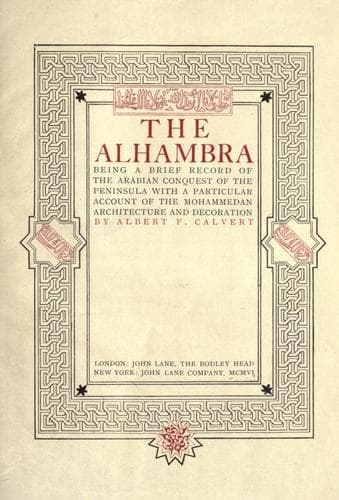
The Alhambra: being a brief record of the Arabian conquest of the Peninsula with a particular account of the Mohammedan architecture and decorationCalvert, Albert Frederick
Islamic
The Alhambra: being a brief record of the Arabian conquest of the Peninsula with a particular account of the Mohammedan architecture and decoration
Of the many beautiful arches which adorn the Palace, the one forming the
entrance to the central alcove, or divan, of the Hall of Justice is
perhaps the most remarkable; the exquisite form of the arch and
richly-ornamented spandril with the poetic inscription which encloses
it--“May power everlasting and imperishable glory be the destiny of the
owner of this Palace”--and the slender porcelaine columns from which it
springs, exciting the deepest admiration.
In this Hall are the famous paintings on leather, ascribed to the end of
the fourteenth century. The painting of a group of Moslems, apparently
congregated in Council, merits close attention, as giving the veritable
costume of the Moors in Granada of the fourteenth century, at which
period the delineations were certainly made, and, in all probability, by
an Italian artist working under Moslem direction. Other paintings
portray various chivalrous or amatory subjects; or they may be taken to
represent romantic episodes as legendary as the story of the Chinese
lovers on a willow-pattern plate. One scene (see p. 47) represents a
wicked magician, or wild man of the woods,
[Illustration: HALL OF JUSTICE AND COURT OF THE LIONS.]
coercing a Christian maiden, who, nevertheless, is holding a docile lion
by a leading chain; the compliant animal meanwhile permitting domestic
fowl and other pretty wantons to play undismayed around him. A Christian
warrior on horseback makes short work of the wild man; but, alas! for
the maiden, a valiant Moor comes galloping up, at once transfixes the
Christian rescuer with his spear, and presumably claims the beautiful
captive as the reward of his prowess. This episode of a Moor killing a
Christian may be taken as a strong presumption of the paintings being
wrought under Mohammedan influence, as it appears most unlikely that it
would have been so represented by a Spaniard after the conquest of
Granada. Some spectators in the upper chamber of a tower in the
background seem to heartily approve of the whole proceeding.
[Illustration: HALL OF JUSTICE.]
However fantastic these pictures may be, they are at least unique, and,
as such, must be regarded with the utmost interest. We may conjecture
that the painter fell into the hands of the Moors by the fortune of war;
or, on the other hand, came by invitation to Granada.
Public-domain text, read in full here on John Shaqi.
Reviews
Reviews
No reviews yet
Be the first to share your thoughts on this work.
Join the Discussion
Join the discussion
Sign in to leave a comment or review.
Sign InorCreate an account