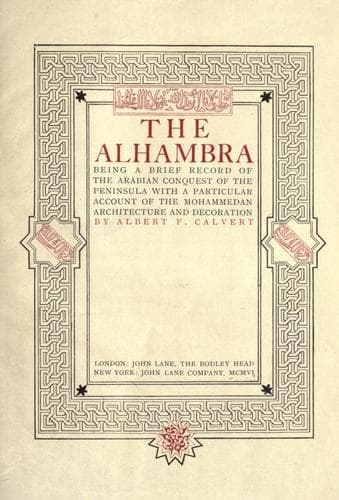
The Alhambra: being a brief record of the Arabian conquest of the Peninsula with a particular account of the Mohammedan architecture and decorationCalvert, Albert Frederick
Islamic
The Alhambra: being a brief record of the Arabian conquest of the Peninsula with a particular account of the Mohammedan architecture and decoration
The main facts connected with the fate of the chieftains of that
generous but devoted race seem to have been ascertained, leaving little
doubt of this hall having been the scene of their calamitous end. Alas!
that boudoirs made for love and life should witness scenes of hatred and
of death; and let none presume to “peep and botanize” over-much, for
nothing is more certain than that heroic blood can never be effaced,
still less if shed in most unnatural murder. Nor, according to Lady
Macbeth, will “all the perfumes of Arabia” serve to sweeten the foul
deed. The blood at least is genuine to all intentions of romance as that
of “the gentle Lutenist” at Holyrood, or of Becket at the shrine of
Canterbury. It behoves us to beware of those dull people who, deprived
of imagination, pretend to judgment; and who would abolish the midsummer
fairies, or proscribe old Æsop; there is no faith in them.
All who visit the Alhambra are sure to make for the fountain
[Illustration: HALL OF THE ABENCERRAGES (BENI CERRAJ).]
where the Abencerrages were beheaded, the more credulous looking with
interest upon the natural reddish-brown veins of the marble, which are
supposed to be indelible blood-stains. It is said that Boabdil resolved
upon the extirpation of the noble family of the Abencerrages in
consequence of the alleged discovery of an intrigue, including a false
charge of infidelity against his gentle queen, and directed the
decapitation of thirty-six of
[Illustration: MOSAIC--HALL OF THE ABENCERRAGES.]
them in this Hall. The story has passed into ballads, dramas, and
romances, until it has grown too strong to be eradicated. Boabdil,
however, was of a mild and amiable character, if wavering and
irresolute; and too gracious to have ordered so inhuman a massacre as
the execution of thirty-six of not only a gallant, but a powerful and
numerous family, with many friends. The truth is, it was Boabdil’s
father, Muley-Abu-l-Hasen, represented by both Christian and Arabian
chroniclers as of a cruel and ferocious nature, who unjustly put to
death some cavaliers of the illustrious line upon suspicion of their
being engaged in a conspiracy to dispossess him.
It so happens that the fame of Boabdil the Unlucky can be cleared of
such infamy as the wholesale massacre of the Abencerrages through direct
evidence afforded by a contemporary Hispano-Moresque ballad, “_Ay de mi
Alhama!_” written in 1482, and which Lord Byron has made familiar by his
version, “_A very mournful Ballad on the siege and conquest of Alhama._”
The fact that Muley-Abu-l-Hasen in vain invested the castle and town of
Alhama[11] after its capture by the Marquis of Cadiz, and the direct
reference in the ballad to its loss, ascribed to the wrath of Allah at
the wickedness of the King, clearly exonerates Boabdil from the crime of
his father.
* * * * *
Public-domain text, read in full here on John Shaqi.
Reviews
Reviews
No reviews yet
Be the first to share your thoughts on this work.
Elsewhere in the archive
Join the Discussion
Join the discussion
Sign in to leave a comment or review.
Sign InorCreate an account