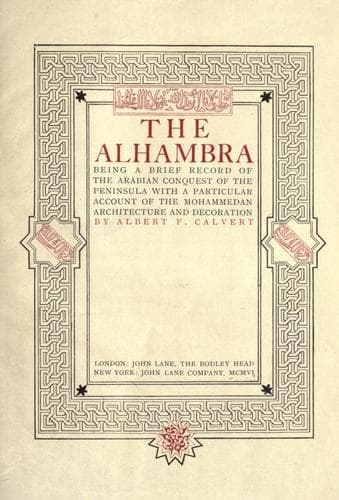
The Alhambra: being a brief record of the Arabian conquest of the Peninsula with a particular account of the Mohammedan architecture and decorationCalvert, Albert Frederick
Islamic
The Alhambra: being a brief record of the Arabian conquest of the Peninsula with a particular account of the Mohammedan architecture and decoration
The transverse section of the Court, looking towards the palace of
Charles V. (see p. 356), forms a beautiful arcade: the slender columns
which support the arches would appear unequal to their superincumbent
weight were not the spandrils lightened by perforations. The
construction of these arches is remarkable for its simplicity. Over the
columns, which are of white marble, are built brick piers, and the
spandrils of the arches are filled in with tiles placed diagonally. To
these are attached perforated plaster ornaments, which give a
singularly light and elegant appearance to the arches, and at the same
time, by freely admitting currents of air, distribute a delicious
coolness through the Courts.
It will be observed that the ornaments in plaster, with which the walls
of the Court of the Fish-pond are covered, are in a better state of
preservation than similar decorations in other parts of the Palace.
The windows over the entrance doorway are formed of ribs of plaster, and
it is thought that these were once filled with stained glass. No traces
of such glazing can now be discovered; the conjecture seems to have
arisen from the fact that a wall here, next the Hall of Ambassadors, has
similar blank windows in which small spaces are painted of various
colours. Between the windows, and at the angles, are four escutcheons of
the Kings of Granada with the oft-repeated motto: “There is no Conqueror
but God;” the whole being enclosed within a cipher, formed by the word
signifying “Grace” written twice in Cufic characters, and so interwoven
that it may be read from right to left, and from left to right. On the
ribs of the window is the word signifying “Blessing,” in Cufic
characters, with this peculiarity, that the first two letters are
enclosed within a cipher formed by the two last. This device also is so
ingeniously written that the word may be read both ways. On six
escutcheons, at the sides, the word signifying “Blessing” is treated in
the same skilful manner.
Immediately over the Mosaic under the gallery is an inscription of
twelve verses in African characters, full of Oriental hyperbole, but
perhaps inferior in composition to those already selected from the Hall
of The Two Sisters.
Under the galleries, at the north and south ends of the Court, are four
recesses, profusely ornamented, elaborate, and
[Illustration: THE COURT OF THE FISH-POND.]
beautiful; well preserved, and retaining much of their original colour.
From amongst the inscriptions of the Court of the Fish-pond it may be
permitted to print two or three:
“Go and tell true believers that Divine help and ready victory are
reserved for them. (From the sixty-first chapter of the Koràn).
“I am like the nuptial array of a bride, endowed with every beauty and
perfection.
“Truly, Ibn Nasr is the sun, shining in splendour;
“May he continue in the noon-tide of his glory even unto the period of
his decline.”
[Illustration: GALLERY IN THE COURT OF THE FISH-POND; OR, OF THE
MYRTLES.]
Public-domain text, read in full here on John Shaqi.
Reviews
Reviews
No reviews yet
Be the first to share your thoughts on this work.
Elsewhere in the archive
Join the Discussion
Join the discussion
Sign in to leave a comment or review.
Sign InorCreate an account