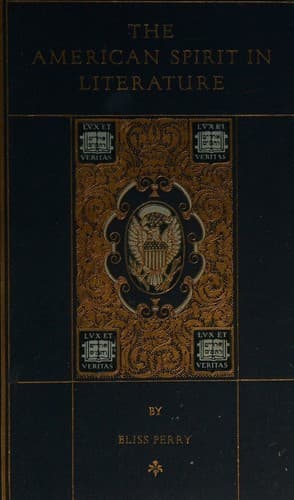
The American Spirit in Literature: A Chronicle of Great InterpretersPerry, Bliss
History
The American Spirit in Literature: A Chronicle of Great Interpreters
Perry, Bliss
American literature -- History and criticism
But the skill was very noticeable also. Irving's prose is not that of
the Defoe-Swift-Franklin-Paine type of plain talk to the crowd. It is
rather an inheritance from that other eighteenth century tradition, the
conversation of the select circle. Its accents were heard in Steele and
Addison and were continued in Goldsmith, Sterne, Cowper, and Charles
Lamb. Among Irving's successors, George William Curtis and Charles
Dudley Warner and William Dean Howells have been masters of it likewise.
It is mellow human talk, delicate, regardful, capable of exquisite
modulation. With instinctive artistic taste, Irving used this old and
sound style upon fresh American material. In Rip van Winkle and The
Legend of Sleepy Hollow he portrayed his native valley of the Hudson,
and for a hundred years connoisseurs of style have perceived the
exquisite fitness of the language to the images and ideas which Irving
desired to convey. To render the Far West of that epoch this style is
perhaps not "big" and broad enough, but when used as Irving uses it in
describing Stratford and Westminster Abbey and an Old English Christmas,
it becomes again a perfect medium. Hawthorne adopted it for Our Old
Home, and Englishmen recognized it at once as a part of their own
inheritance, enriched, like certain wines, by the voyage across the
Atlantic and home again. Irving wrote of England, Mr. Warner once said,
as Englishmen would have liked to write about it. When he described the
Alhambra and Granada and the Moors, it was the style, rich both in
physical sensation and in dreamlike reverie, which revealed to the world
the quick American appreciation of foreign scenes and characters. Its
key is sympathy.
Irving's popularity has endured in England. It suffered during the
middle of the century in his own country, for the strongest New England
authors taught the public to demand more thought and passion than were
in Irving's nature. Possibly the nervous, journalistic style of the
twentieth century allows too scanty leisure of mind for the full
enjoyment of the Knickerbocker flavor. Yet such changes as these in
literary fashion scarcely affect the permanent service of Irving to our
literature. He immortalized a local type--the New York Dutchman--and
local legends, like that of Rip van Winkle; he used the framework of the
narrative essay to create something almost like the perfected short
story of Poe and Hawthorne; he wrote prose with unfailing charm in an
age when charm was lacking; and, if he had no message, it should be
remembered that some of the most useful ambassadors have had none save
to reveal, with delicacy and tact and humorous kindness, the truth that
foreign persons have feelings precisely like our own.
Public-domain text, read in full here on John Shaqi.
Reviews
Reviews
No reviews yet
Be the first to share your thoughts on this work.
Join the Discussion
Join the discussion
Sign in to leave a comment or review.
Sign InorCreate an account