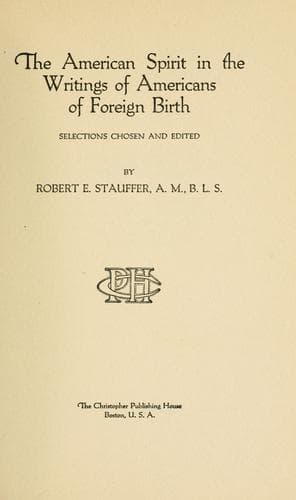
The American Spirit in the Writings of Americans of Foreign Birth
General
The American Spirit in the Writings of Americans of Foreign Birth
American literature; Americanization; Noncitizens -- United States
As I read about the noble boy who would not tell a lie to save
himself from punishment, I was for the first time truly repentant
of my sins. Formerly I had fasted and prayed and made sacrifice on
the Day of Atonement, but it was more than half play, in mimicry of
my elders. I had no real horror of sin, and I knew so many ways of
escaping punishment. I am sure my family, my neighbors, my teachers
in Polotzk--all my world, in fact--strove together, by example and
precept, to teach me goodness. Saintliness had a new incarnation in
about every third person I knew. I did respect the saints, but I could
not help seeing that most of them were a little bit stupid, and that
mischief was much more fun than piety. Goodness, as I had known it,
was respectable, but not necessarily admirable. The people I really
admired, like my Uncle Solomon and Cousin Rachel, were those who
preached the least and laughed the most. My sister Frieda was perfectly
good, but she did not think the less of me because I played tricks.
What I loved in my friends was not inimitable. One could be downright
good if one really wanted to. One could be learned if one had books and
teachers. One could sing funny songs and tell anecdotes if one traveled
about and picked up such things, like one’s uncles and cousins. But a
human being strictly good, perfectly wise, and unfailingly valiant,
all at the same time, I had never heard or dreamed of. This wonderful
George Washington was as inimitable as he was irreproachable. Even if
I had never, never told a lie, I could not compare myself to George
Washington; for I was not brave,--I was afraid to go out when snowballs
whizzed,--and I could never be the First President of the United States.
So I was forced to revise my own estimate of myself. But the twin of
my new-born humility, paradoxical as it may seem, was a sense of
dignity I had never known before. For if I found that I was a person
of small consequence, I discovered at the same time that I was more
nobly related than I had ever supposed. I had relatives and friends
who were notable people by the old standards,--and I had never been
ashamed of my family,---but this George Washington, who died long
before I was born, was like a king in greatness, and he and I were
Fellow-Citizens. There was a great deal about Fellow-Citizens in the
patriotic literature we read at this time; and I knew from my father
how he was a Citizen through the process of naturalization, and how I
also was a Citizen by virtue of my relation to him. Undoubtedly I was
a Fellow-Citizen, and George Washington was another. It thrilled me to
realize what sudden greatness had fallen on me, and at the same time
sobered me, as with a sense of responsibility. I strove to conduct
myself as befitted a Fellow-Citizen.
Public-domain text, read in full here on John Shaqi.
Reviews
Reviews
No reviews yet
Be the first to share your thoughts on this work.
Elsewhere in the archive
Join the Discussion
Join the discussion
Sign in to leave a comment or review.
Sign InorCreate an account