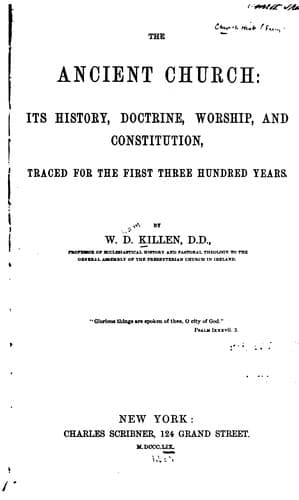
The Ancient Church: Its History, Doctrine, Worship, and ConstitutionKillen, W. D. (William Dool)
Religion
The Ancient Church: Its History, Doctrine, Worship, and Constitution
Killen, W. D. (William Dool)
Church history -- Primitive and early church, ca. 30-600
the Apostle John, "believe not every spirit, but _try the spirits_
whether they are of God. .... We are of God, _he that knoweth God
heareth us_, he that is not of God heareth not us. Hereby know we the
spirit of truth and the spirit of error." [49:1] "If there come _any_
unto you, and _bring not this doctrine_, receive him not into your
house, neither bid him God-speed; for he that biddeth him God-speed is
partaker of his evil deeds." [49:2] Paul declares, still more
emphatically--"Though WE, or AN ANGEL FROM HEAVEN, preach any other
gospel unto you than that which we have preached unto you, _let him be
accursed_. As we said before, so say I now again, If _any man_ preach
any other gospel unto you than that ye have received, _let him be
accursed_." [49:3]
In one sense neither the Twelve nor the Seventy had successors. All of
them were called to preach the gospel by the living voice of Christ
himself; all had "companied" with Him during the period of His ministry;
all had listened to His sermons; all had been spectators of His works of
wonder; all were empowered to perform miracles; all seem to have
conversed with Him after His resurrection; and all appear to have
possessed the gift of inspired utterance. [50:1] But in another sense
every "good minister of Jesus Christ" is a successor of these primitive
preachers; for every true pastor is taught of God, and is moved by the
Spirit to undertake the service in which he is engaged, and is warranted
to expect a blessing on the truth which he disseminates. As of old the
descent from heaven of fire upon the altar testified the Divine
acceptance of the sacrifices, so now the descent of the Spirit, as
manifested in the conversion of souls to God, is a sure token that the
labours of the minister have the seal of the Divine approbation. The
great Apostle of the Gentiles did not hesitate to rely on such a proof
of his commission from heaven. "Need we," says he to the Corinthians,
"epistles of commendation to you, or letters of commendation from you?
Ye are our epistle written in our hearts, known and read of all men;
forasmuch as ye are manifestly declared to be the epistle of Christ
ministered by us, written, not with ink, but with the Spirit of the
living God, not in tables of stone, but in the fleshy tables of the
heart." [50:2] No true pastor will be left entirely destitute of such
encouragement, and neither the Twelve nor the Seventy could produce
credentials more trustworthy or more intelligible.
CHAPTER IV.
THE PROGRESS OF THE GOSPEL FROM THE DEATH OF CHRIST TO THE DEATH OF
THE APOSTLE JAMES, THE BROTHER OF JOHN.
A.D. 31 TO A.D. 44.
When our Lord bowed His head on the cross and "gave up the ghost," the
work of atonement was completed. The ceremonial law virtually expired
when He explained, by His death, its awful significance; and the crisis
of His passion was the birthday of the Christian economy. At this date
the history of the New Testament Church properly commences.
Public-domain text, read in full here on John Shaqi.
Reviews
Reviews
No reviews yet
Be the first to share your thoughts on this work.
Join the Discussion
Join the discussion
Sign in to leave a comment or review.
Sign InorCreate an account