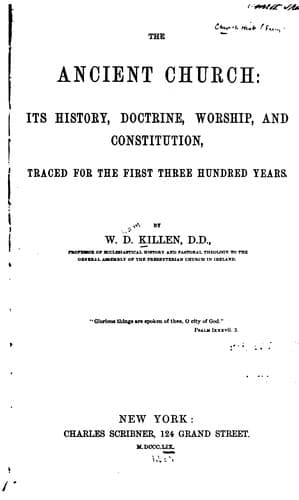
The Ancient Church: Its History, Doctrine, Worship, and ConstitutionKillen, W. D. (William Dool)
Religion
The Ancient Church: Its History, Doctrine, Worship, and Constitution
Killen, W. D. (William Dool)
Church history -- Primitive and early church, ca. 30-600
Seventy, of even one presbyter or pastor. With the exception of the
laying on of hands upon the seven deacons, [47:4] no inspired writer
mentions any act of the kind in which the Twelve ever engaged. The
deacons were not _rulers_ in the Church, and therefore could not by
ordination confer ecclesiastical power on others.
There is much meaning in the silence of the sacred writers respecting
the official proceedings and the personal career of the Twelve and the
Seventy. It thus becomes impossible for any one to make out a title to
the ministry by tracing his ecclesiastical descent; for no contemporary
records enable us to prove a connexion between the inspired founders of
our religion, and those who were subsequently entrusted with the
government of the Church. At the critical point where, had it been
deemed necessary, we might have had the light of inspiration, we are
left to wander in total darkness. We are thus shut up to the conclusion
that the claims of those who profess to be heralds of the gospel are to
be tested by some other criterion than their ecclesiastical lineage. It
is written--"_By their fruits_ ye shall know them." [48:1] God alone can
make a true minister; [48:2] and he who attempts to establish his right
to feed the flock of Christ by appealing to his official genealogy
miserably mistakes the source of the pastoral commission. It would,
indeed, avail nothing though a minister could prove his relationship to
the Twelve or the Seventy by an unbroken line of ordinations, for some
who at the time may have been able to deduce their descent from the
apostles were amongst the most dangerous of the early heretics. [48:3]
True religion is sustained, not by any human agency, but by that Eternal
Spirit who quickens all the children of God, and who has preserved for
them a pure gospel in the writings of the apostles and evangelists. The
perpetuity of the Church no more depends on the uninterrupted succession
of its ministers than does the perpetuity of a nation depend on the
continuance of the dynasty which may happen at a particular date to
occupy the throne. As plants possess powers of reproduction enabling
them, when a part decays, to throw it off, and to supply its place by a
new and vigorous vegetation, so it is with the Church--the spiritual
vine which the Lord has planted. Its government may degenerate into a
corrupt tyranny by which its most precious liberties may be invaded or
destroyed, but the freemen of the Lord are not bound to submit to any
such domination. Were even all the ecclesiastical rulers to become
traitors to the King of Zion, the Church would not therefore perish. The
living members of the body of Christ would be then required to repudiate
the authority of overseers by whom they were betrayed, and to choose
amongst themselves such faithful men as were found most competent to
teach and to guide the spiritual community. The Divine Statute-book
clearly warrants the adoption of such an alternative. "Beloved," says
Public-domain text, read in full here on John Shaqi.
Reviews
Reviews
No reviews yet
Be the first to share your thoughts on this work.
Join the Discussion
Join the discussion
Sign in to leave a comment or review.
Sign InorCreate an account