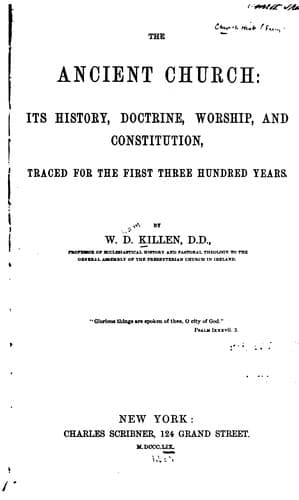
The Ancient Church: Its History, Doctrine, Worship, and ConstitutionKillen, W. D. (William Dool)
Religion
The Ancient Church: Its History, Doctrine, Worship, and Constitution
Killen, W. D. (William Dool)
Church history -- Primitive and early church, ca. 30-600
Prior to the election of the deacons, Peter and John had been
incarcerated. The Sanhedrim wished to extort from them a pledge that
they would "not speak at all nor teach in the name of Jesus," [55:1] but
the prisoners nobly refused to consent to any such compromise. They
"answered and said unto them--Whether it be right in the sight of God to
hearken unto you more than unto God, judge ye." [55:2] The apostles here
disclaimed the doctrine of passive obedience, and asserted principles
which lie at the foundation of the true theory of religious freedom.
They maintained that "God alone is Lord of the conscience"--that His
command overrides all human regulations--and that, no matter what may be
the penalties which earthly rulers may annex to the breach of the
enactments of their statute-book, the Christian is not bound to obey,
when the civil law would compel him to violate his enlightened
convictions. But the Sanhedrim obviously despised such considerations.
For a time they were obliged to remain quiescent, as public feeling ran
strongly in favour of the new preachers; but, soon after the election of
the deacons, they resumed the work of persecution. The tide of
popularity now began to turn; and Stephen, one of the Seven,
particularly distinguished by his zeal, fell a victim to their
intolerance.
The martyrdom of Stephen appears to have occurred about three years and
a half after the death of our Lord. [55:3] Daniel had foretold that the
Messiah would "confirm the covenant with many _for one week_" [55:4]--an
announcement which has been understood to indicate that, at the time of
his manifestation, the gospel would be preached with much success among
his countrymen _for seven years_--and if the prophetic week commenced
with the ministry of John the Baptist, it probably terminated with this
bloody tragedy. [56:1] The Christian cause had hitherto prospered in
Jerusalem, and there are good grounds for believing that, mean while, it
had also made considerable progress throughout all Palestine; but, at
this date, it is suddenly arrested in its career of advancement. The
Jewish multitude begin to regard it with aversion; and the Roman
governor discovers that he may, at any time, obtain the tribute of their
applause by oppressing its ablest and most fearless advocates.
Public-domain text, read in full here on John Shaqi.
Reviews
Reviews
No reviews yet
Be the first to share your thoughts on this work.
Join the Discussion
Join the discussion
Sign in to leave a comment or review.
Sign InorCreate an account