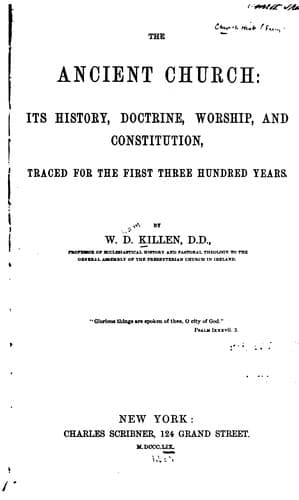
The Ancient Church: Its History, Doctrine, Worship, and ConstitutionKillen, W. D. (William Dool)
Religion
The Ancient Church: Its History, Doctrine, Worship, and Constitution
Killen, W. D. (William Dool)
Church history -- Primitive and early church, ca. 30-600
In the treatment of Paul by his unbelieving countrymen we have a most
melancholy illustration of the recklessness of religious bigotry. These
Jews must have known that, in as far as secular considerations were
concerned, he had everything to lose by turning into "the way which they
called heresy;" they were bound to acknowledge that, by connecting
himself with an odious sect, he at least demonstrated his sincerity and
self-denial; but they were so exasperated by his zeal that they "took
counsel to kill him." [62:1] When, after his sojourn in Arabia, he
returned to Damascus that city was in the hands of Aretas, the king of
Arabia Petraea; [62:2] who seems to have contrived to gain possession of
it during the confusion which immediately followed the death of the
Emperor Tiberius. This petty sovereign courted the favour of the Jewish
portion of the population by permitting them to persecute the disciples;
[62:3] and the apostle, at this crisis, would have fallen a victim to
their malignity had not his friends let him down "through a window, in a
basket, by the wall," [62:4] and thus enabled him to escape a premature
martyrdom. He now repaired to Jerusalem, where the brethren do not
appear to have heard of his conversion, and where they at first refused
to acknowledge him as a member of their society; [62:5] for he had been
obliged to leave Damascus with so much precipitation that he had brought
with him no commendatory letters; but Barnabas, who is said to have been
his school-fellow, [62:6] and who had in some way obtained information
respecting his subsequent career, made the leaders of the Mother Church
acquainted with the wonderful change which had taken place in his
sentiments and character, and induced them to admit him to fellowship.
During this visit to the holy city, while he prayed in the temple, he
was more fully instructed respecting his future destination. In a
trance, he saw Jesus, who said to him--"Depart, for I will send thee
_far hence unto the Gentiles_." [62:7] Even had he not received this
intimation, the murderous hostility of the Jews would have obliged him
to retire. "When he spake boldly in the name of the Lord Jesus, and
disputed against the Grecians, they went about to slay him--which, when
the brethren knew, they brought him down to Caesarea, and sent him forth
to Tarsus." [63:1]
Public-domain text, read in full here on John Shaqi.
Reviews
Reviews
No reviews yet
Be the first to share your thoughts on this work.
Elsewhere in the archive
Join the Discussion
Join the discussion
Sign in to leave a comment or review.
Sign InorCreate an account