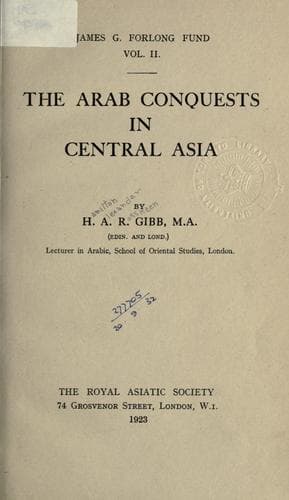
The Arab conquests in Central AsiaGibb, H. A. R. (Hamilton Alexander Rosskeen)
Islamic
The Arab conquests in Central Asia
Gibb, H. A. R. (Hamilton Alexander Rosskeen)
Bukhoro (Uzbekistan) -- History; Islamic Empire; Khanate of Bukhara -- History
The historians give the most contradictory accounts of the events that
followed; according to Balādhurī the new Caliph Sulaymān confirmed
Qutayba in his command but gave permission to the army to disband.
_T_abarī’s narrative, with which Yaʿqūbī’s in general agrees, is fully
discussed by Wellhausen (274 ff.), together with a valuable analysis
of Qutayba’s position. The story of his highhanded negotiations with
Sulaymān is too well known to need repetition. Finding the army
disinclined to follow him, he completely lost his head and roused the
mutiny in which he was killed. The Persian levies, who were inclined to
side with him, were dissuaded by _H_ayyān an-Naba_t_ī, and at the last
only his own family and bodyguard of Sogdian princes remained faithful.
The death of Qutayba marked not merely the end of the Arab conquests in
Central Asia for a quarter of a century, but the beginning of a period
of retrogression. Under Wakīʿ b. Abī Sūd, his successor[69], the armies
melted away. Mukhallad, the son of Yazīd b. Muhallab and his lieutenant
in Transoxania, carried out summer raids on the villages of _S_ughd,
but an isolated attempt on the Jaxartes provinces by ʿOmar’s governor,
Al-Jarrā_h_ b. ʿAbdullah, met with ignominious failure. It is possibly
to this that the tradition, mentioned by Barthold (_Turkestan_ 160),
of the disaster met with by a Muslim army refers. On the other hand an
embassy was sent in the name of the Caliph to renew relations with the
Chinese court, and a third in concert with the kingdoms of _T_ukhāristān
and Samarqand, etc., during the reign of ʿOmar[65]. There is mention also
of an expedition into Khuttal which regained some territory. But it was
Qutayba, with _H_ajjāj at his back, who had held his conquests together,
and when he disappeared there was neither leader nor organisation to take
his place. The history of the next decade clearly shows how loose and
unstable was the authority of the Arabs. It was force that had made the
conquests, and only a settled policy of force or conciliation could hold
them. The first was absent. “Qutayba in chains at the world’s end is more
terrible to us than Yazīd as governor in our very midst” is the graphic
summary put into the mouths of the conquered, while of Rutbīl, king of
Zābulistān, we are told expressly that after the death of _H_ajjāj “he
paid not a cent of tribute to any of the governors of Sijistān on behalf
of the Umayyads nor on behalf of Abū Muslim.”[70].
Public-domain text, read in full here on John Shaqi.
Reviews
Reviews
No reviews yet
Be the first to share your thoughts on this work.
Join the Discussion
Join the discussion
Sign in to leave a comment or review.
Sign InorCreate an account