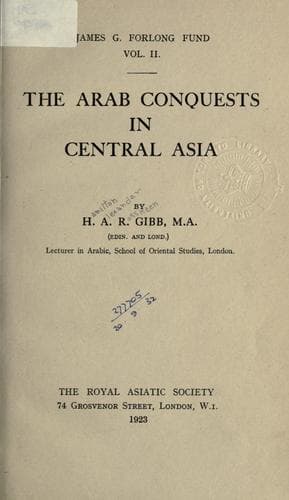
The Arab conquests in Central AsiaGibb, H. A. R. (Hamilton Alexander Rosskeen)
Islamic
The Arab conquests in Central Asia
Gibb, H. A. R. (Hamilton Alexander Rosskeen)
Bukhoro (Uzbekistan) -- History; Islamic Empire; Khanate of Bukhara -- History
Nor was ʿOmar’s policy a true policy of conciliation, based as it was not
on the maintenance of the Arab conquests but on the complete evacuation
of Transoxania. His orders to that effect were of course indignantly
rejected by the Arab colonists in Bukhārā and Samarqand, but together
with his appointment of the feeble and ineffective ʿAbdur-Ra_h_mān b.
Nuʿaym al-Qushayrī as governor, such a policy was naturally construed
by the Sogdians as mere weakness, and an invitation to regain their
independence. In addition to the embassies to China, to be related in
the next chapter, and possibly also some negotiations with the Türgesh,
Ghūrak sought to win back his capital by playing on ʿOmar’s piety.
The Caliph sent envoys to the princes of Sogdiana calling on them to
accept Islām, and Ghūrak, outwardly professing his adherence, sent a
deputation to ʿOmar urging that as “Qutayba dealt with us treacherously
and tyrannically, but God has now caused justice and equity to reign” the
city should be restored to the _S_ughdians. The commonsense of the judge
appointed to try the case on ʿOmar’s instructions by the governor of
Samarqand, Sulaymān b. Abiʾs-Sarī (himself a mawlā), solved the problem
in an eminently practical manner, and we are told that his decision, so
far from being “malicious,” was satisfactory to both the Arabs and the
_S_ughdians, if not perhaps to Ghūrak. Beyond the remission of kharāj, it
is doubtful whether ʿOmar’s administration benefited the subject peoples
in the slightest, and the reaction which followed his brief reign only
aggravated the situation. Already before its close the _S_ughdians had
withdrawn their allegiance[71].
Thus within six years from the death of Qutayba, much of his work was
undone. He had laid the foundations on which the later rule of Islām
was built, and laid them well, though his own superstructure was too
flimsy to withstand the tempests of the years ahead. But the fault was
not entirely, perhaps not even chiefly, the fault of the builder. He was
snatched away before his work was done, even if in his latter years he
tended to neglect everything else for military glory. As we shall see,
there was no peace in Transoxania until other men arose, great and strong
enough to adopt and carry out the best of his plans. The ruthlessness
and ferocity of his conquests, however, have been much exaggerated.
He was always ready to use diplomacy rather than force if it offered
any hope of success, so much so that his lenience was misconstrued on
occasion by both friends and foes. Only in cases of treachery and revolt
his punishment came swift and terrible. That he did not hesitate to take
vengeance on his private enemies is to say no more than that he was an
Arab. It was not without reason that in later days the Muslims of Central
Asia added Qutayba’s name to the roll of martyrs and that his tomb in
Farghāna became a favourite place of pilgrimage[72].
Public-domain text, read in full here on John Shaqi.
Reviews
Reviews
No reviews yet
Be the first to share your thoughts on this work.
Join the Discussion
Join the discussion
Sign in to leave a comment or review.
Sign InorCreate an account