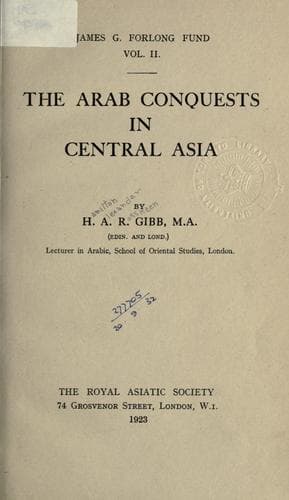
The Arab conquests in Central AsiaGibb, H. A. R. (Hamilton Alexander Rosskeen)
Islamic
The Arab conquests in Central Asia
Gibb, H. A. R. (Hamilton Alexander Rosskeen)
Bukhoro (Uzbekistan) -- History; Islamic Empire; Khanate of Bukhara -- History
To sum up the position in Central Asia in the years immediately following
Qutayba’s conquests:—
(1) Lower _T_ukhāristān and Chaghāniān formed an integral part
of the Arab Empire.
(2) _T_ukhāristān, now in the decay of its power, was held
as a vassal state, together with the Transoxine provinces of
Khuttal, Kumādh, etc., where, however, the Arab authority was
much weaker.
(3) In Sogdiana, Bukhārā was regarded as a permanent conquest
and gradually colonized; _S_ughd was still hostile territory
held by strong outpost garrisons in Samarqand and Kish,
connected to Bukhārā by minor posts.
(4) Khwārizm as a military power was negligible and was
permanently colonized.
(5) The kingdoms beyond the Jaxartes remained independent,
hostile, and relatively strong, supported by the Turkish power
to the North East and also by the intervention of China.
(6) Ushrūsana, though unsubdued, does not seem to have offered
any obstacle to the passage of Arab armies.
(7) The existing dynastic houses were everywhere maintained, as
the representatives of the conquered peoples and vehicle of the
civil administration. The actual administrative and financial
authority in their territories, however, passed to the Wāli,
or agent of the Arab governor of Khurāsān[73].
NOTES
[41] Chav. Doc. 42, 282 f.: Marquart Chronologie 15: _T_abarī II. 1078,
1080.
[42] As was suggested by Prof. Houtsma, Gotting. Gelehrt. Anz., 1899,
386-7.
[43] Suggested readings in Barthold, Turkestan, p. 71 n. 5, and p. 76.
[44] _T_ab. 1184 f., 1195: Chav. Doc. 172: Hamadhānī, Kitāb al-Buldān
(Bibl. Geog. Arab. V) 209. 7: _cf._ _T_ab. 1874.
[45] Narshakhī 8, 15, 30, 37, 44: _T_ab. 1199. 1: Yaʿqūbī Hist. II. 342.
9. _Cf._ Marquart, Chronologie 63 and Barthold, Arab. Quellen 7.
[46] _H_amāsa, ed. Freytag, I. 349.
[47] Narshakhī 8. 15.
[48] _T_ab. 1207. 16: _cf._ Yaʿqūbī loc. cit. On the Arab method of
crucifixion, Nöldeke Z.D.M.G. LVI (1902) 433; _cf._ _T_ab. 1691 and
Dīnawarī 336. 18.
[49] Detailed accounts of this are readily accessible in “The Heart of
Asia”, and “The Caliph’s Last Heritage” by Sir Mark Sykes, the latter
in a richly imaginative vein. Very full geographical data are given by
Marquart, Ērānshahr 219 f.
[50] Narsh. 46. 12, 50. 15.
[51] _E.g._ Narsh. 58. 5. On the new city, Barthold Turkestan 110 f.
[52] _E.g._ _T_ab. 1544. 9, 1600 ff.
[53] On this dynasty see Ērānshahr 37 f., 248 ff. and de Goeje in
W.Z.K.M. XVI (1902) 192-195.
[54] Yaʿqūbī Geog. 283: Chav. Doc. 161.
[55] The pronunciation of this name, usually pointed Ghūzak, is fixed by
the Chinese transcription U-le-kia (Chav. Doc. 136).
[56] On the city of Khwārizm (Fīl, Kath) see Sachau “Zur Geschichte usw.
von Khwārizm” pp. 23-25.
Public-domain text, read in full here on John Shaqi.
Reviews
Reviews
No reviews yet
Be the first to share your thoughts on this work.
Join the Discussion
Join the discussion
Sign in to leave a comment or review.
Sign InorCreate an account