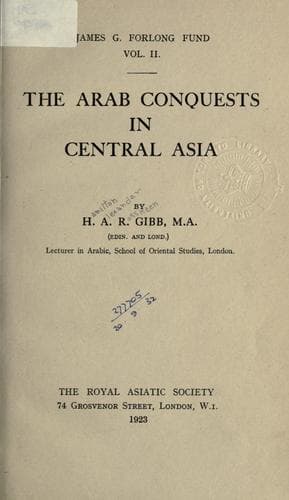
The Arab conquests in Central AsiaGibb, H. A. R. (Hamilton Alexander Rosskeen)
Islamic
The Arab conquests in Central Asia
Gibb, H. A. R. (Hamilton Alexander Rosskeen)
Bukhoro (Uzbekistan) -- History; Islamic Empire; Khanate of Bukhara -- History
The princes of Transoxania had so long been accustomed to regard the
Arabs as mere marauders that it was some time before they could realise
the loss of their independence. Though necessity forced them at first
to adopt a conciliatory spirit (as, for example, in their acceptance
of Islām under ʿOmar II), they were dismayed to find all the machinery
of permanent occupation set in motion, and their authority flouted
by tactless and greedy Arab officials. Such a state of affairs was
tolerable only in the absence of any countering force. The situation
was not stationary for long, however; even before Qutayba’s death
other and disturbing factors had begun to enter. Our best clue to the
complications in Transoxania during this period is the attitude of
Ghūrak, king of _S_ughd, of whose movements, fortunately, sufficient
indications have been preserved. In maintaining a precarious balance
between the Türgesh and the Arabs, his true statesman’s instinct seldom
misled him in judging how and when to act to advantage throughout his
troubled reign. In addition to this we have the evidence, unreliable
in detail but confirmatory in the mass, of the embassies sent by the
subject principalities to the Chinese court. Doubtless they were
despatched in the guise of commercial missions and in many cases were
truly so, but that they frequently possessed a political character
can hardly be denied. The dates of these embassies as given in the
authorities translated by Chavannes fall naturally into four periods. In
the following list all embassies have been omitted in which the Arabs
are known to have participated or whose object is known to have had no
connection with the Arab conquests, as well as those which appear to be
duplicated, and those from the minor states:
NUMBER OF EMBASSIES FROM:—
1. 717-731 _S_ughd 11, _T_ukhāristān 5, Bukhārā 2, Arabs 4.
2. 732-740 ” none ” 2 ” none ” 1 (733).
3. 741-747 ” 4 ” 3 ” 1 ” 4
4. 750-755 ” 4 ” 2 ” 3 ” 6
These four periods, as will be seen, closely correspond to the
fluctuations of Arab authority in Transoxania.
Public-domain text, read in full here on John Shaqi.
Reviews
Reviews
No reviews yet
Be the first to share your thoughts on this work.
Elsewhere in the archive
Join the Discussion
Join the discussion
Sign in to leave a comment or review.
Sign InorCreate an account