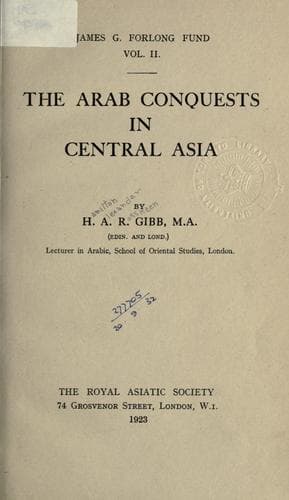
The Arab conquests in Central AsiaGibb, H. A. R. (Hamilton Alexander Rosskeen)
Islamic
The Arab conquests in Central Asia
Gibb, H. A. R. (Hamilton Alexander Rosskeen)
Bukhoro (Uzbekistan) -- History; Islamic Empire; Khanate of Bukhara -- History
The Türgesh, however, were not long in intervening on their own account.
Whatever opportunity the Arab government had to pacify the _S_ughdians
was lost by a succession of incompetent governors. Already in the reign
of ʿOmar II, as has been seen, they had withdrawn their allegiance from
the weak ʿAbdur-Ra_h_mān b. Nuʿaym. For a moment the situation seemed
to improve at the beginning of the governorship of Saʿīd “Khudhayna”
(102/720) owing to the firm handling of Samarqand by his lieutenant
Shuʿba b. _Z_uhayr. But disturbances broke out and Shuʿba was recalled,
perhaps in a vain attempt to appease the insurgents. It would seem that
the _S_ughdians appealed to the new Turkish power in the East and Su-Lu,
unable to make headway against the growing influence of China, willingly
seized the opportunity of diverting his armies into Transoxania. A small
Türgesh force was sent under Köl-chur (called by _T_abarī Kūr_s_ūl)[75]
to make common cause with the _S_ughdian rebels in the following
spring (end of 102). Saʿīd awoke to find the whole country in arms, a
Turkish force marching on Samarqand, and the local princes, with few
exceptions, aiding the invaders. The Arab commanders could not rely on
their levies and a small garrison at Qa_s_r al-Bāhilī was evacuated only
with the utmost difficulty. The tale of their relief by a small force
of volunteers is one of the most spirited narratives of adventure in
_T_abarī. But such episodes did not affect the general success of the
Turkish forces. Kūr_s_ūl continued his advance through _S_ughd without
opposition, avoiding Samarqand, until at last Saʿīd was roused by public
reproach to march against the Turks. After a small initial success, which
he refused to follow up, he was severely defeated and confined to the
neighbourhood of Samarqand. The Turks were not strong enough to undertake
a siege of the city, as the whole operation seems to have been little
more than a reconnaissance in force combined with a raiding expedition.
As the Türgesh retired, the Arab cavalry followed them up as far as
Waraghsar, the head of the canal system of _S_ughd. Ghūrak appears to
have refrained from committing himself by openly aiding the rebels, and
doubtless recognised that the Arabs were not so easily to be dislodged.
From the fact that Saʿīd’s camp was pitched at Ishtīkhan, in close
proximity to him, it may even be conjectured that he outwardly supported
the Arabs.
Public-domain text, read in full here on John Shaqi.
Reviews
Reviews
No reviews yet
Be the first to share your thoughts on this work.
Elsewhere in the archive
Join the Discussion
Join the discussion
Sign in to leave a comment or review.
Sign InorCreate an account