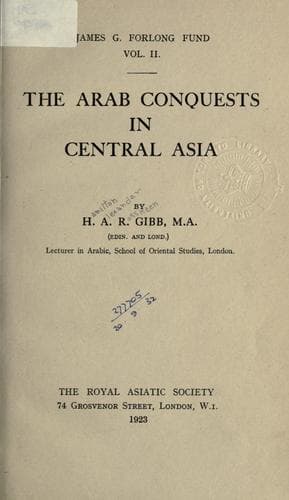
The Arab conquests in Central AsiaGibb, H. A. R. (Hamilton Alexander Rosskeen)
Islamic
The Arab conquests in Central Asia
Gibb, H. A. R. (Hamilton Alexander Rosskeen)
Bukhoro (Uzbekistan) -- History; Islamic Empire; Khanate of Bukhara -- History
The expedition to Khujanda may be put in the spring and summer of
722 (end of 103, beginning of 104), though the chronology here, and
indeed for all this period, is uncertain. The piecemeal reduction of
the fortresses in _S_ughd occupied the remainder of the year, a series
of operations whose difficulty is sufficient witness to the effect of
the news from Khujanda in stiffening the resistance to the Arabs. The
first fortress to be attacked was that of Abghar, in which a band of
the emigrants had settled. The attack was entrusted to Sulaymān b.
Abiʾs-Sarī, with an army composed largely of native levies from Bukhārā,
Khwārizm, and Shūmān, accompanied by their princes. Sulaymān persuaded
the dihqān to surrender, and sent him to al-_H_arashī, who at first
treated him well in order to counteract the effect of the massacre of
Khujanda, but put him to death after recapturing Kish and Rabinjān. The
most inaccessible fortress and the crowning example of Al-_H_arashī’s
perfidy were left to the last. The dihqān Subuqrī still held out in the
fortress of Khuzar, to the south of Nasaf; unable to take it by force,
Al-_H_arashī sent Musarbal b. Al-Khirrīt, a personal friend of Subuqrī,
to offer him a pardon. On his surrender, he was sent to Merv and put to
death, although the amnesty, it is said, had been confirmed by ʿOmar b.
Hubayra.
The whole of _S_ughd was thus once more in the hands of the Arabs. The
nearer districts, Khwārizm and Bukhārā, had remained loyal and the Oxus
basin seems to have been unaffected. But to make a solitude and call it
peace did not suit the aims of the Arab government and Al-_H_arashī found
that his “policy of thorough” only provided Ibn Hubayra with an excuse
for superseding him. During the winter, therefore, he was replaced by
Muslim b. Saʿīd al-Kilābī, who, as the grandson of Aslam b. Zurʿa, came
of a house long familiar with Khurāsān. The danger of the movement of
revolt spreading to the Iranians of Khurāsān seems to have preoccupied
the Arab government during all this period. Saʿīd Khudhayna had poisoned
the too-influential _H_ayyān an-Naba_t_ī on suspicion of rousing the
Persians against the government and that it was felt even in Ba_s_ra
may be seen from Ibn Hubayra’s advice to his new governor, “Let your
chamberlain be one who can make peace with your mawālī.” Muslim, in fact,
favoured the Persians and did all in his power to appoint officials
acceptable to them, the Mazdean Bahrām Sīs, for example, being appointed
Marzubān of Merv[77]. But all such measures were merely palliatives
and could not materially affect the growing discontent in _S_ughd and
_T_ukhāristān. During his first year of office it is recorded (if the
narrative is not, as Wellhausen thinks, a duplicate of the raid on
Farghāna in the following year) that Muslim marched across the river
but was met and pushed back into Khurāsān by a Turkish army, narrowly
escaping disaster. It is not improbable that the local forces were again
Public-domain text, read in full here on John Shaqi.
Reviews
Reviews
No reviews yet
Be the first to share your thoughts on this work.
Elsewhere in the archive
Join the Discussion
Join the discussion
Sign in to leave a comment or review.
Sign InorCreate an account