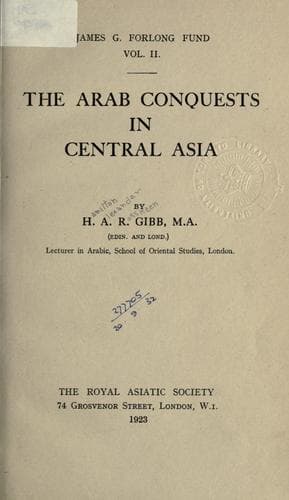
The Arab conquests in Central AsiaGibb, H. A. R. (Hamilton Alexander Rosskeen)
Islamic
The Arab conquests in Central Asia
Gibb, H. A. R. (Hamilton Alexander Rosskeen)
Bukhoro (Uzbekistan) -- History; Islamic Empire; Khanate of Bukhara -- History
This disaster, which is known as the “Day of Thirst,” marks a period in
the history of the Arab conquests. It was practically the last aggressive
expedition of the Arabs into Transoxania for fifteen years, but of
much greater importance was the blow which it struck at Arab prestige.
The rôles were reversed; from now onwards the Arabs found themselves
on the defensive and were gradually ousted from almost every district
across the Oxus. No wonder, therefore, that the memory of the “Day of
Thirst” rankled even long after it had been avenged[78]. According to
the Arab tradition, the Türgesh armies were led on this occasion not by
Su-Lu himself, but by one of his sons. Unfortunately the accounts of
Su-Lu in such Chinese works as have been translated are silent on his
Western expeditions, and the Arab historians are our only authorities.
The immediate result of the Arab defeat, not only in _S_ughd but in
_T_ukhāristān and the southern basin as well, was to stiffen the attitude
of passive resistance to the Arabs to the point at which it only needed
active support to break into a general conflagration. From this time,
if not before, the subject princes regarded the Türgesh as the agents
of their deliverance, commissioned by China in response to the urgent
entreaties they had addressed to the Emperor for aid in their struggle.
We find this actually expressed in a letter sent three years later by
the Jabghu of _T_ukhāristān, which is, in Chavannes’ words “but one long
cry of distress”[79]. “I am loaded with heavy taxation by the Arabs;
in truth, their oppression and our misery are extreme. If I do not
obtain the help of the (Chinese) Kagan ... my kingdom will certainly be
destroyed and dismembered.... I have been told that the Celestial Kagan
has given this order to the Kagan of the Türgesh: To you I delegate the
affairs of the Far West; you must at once send soldiers to drive out
the Arabs.” The point of view here expressed is of course that of the
ruling princes, whose resentment at the curtailment of their authority is
understandable. Besides making allowance for some natural exaggeration,
it would be dangerous to assume that this was as yet fully shared by the
people. In all probability, if we may judge from historical analogies,
there was also a pro-Arab party in Sogdiana, who felt that the best
interests of the country lay, not in an opposition whose final issue
could scarcely be in doubt, but in co-operation with their new masters as
far as was possible. The tragedy of the Arab administration was that by
alternately giving and refusing co-operation on its side, it drove its
supporters in the end to make common cause with its opponents.
Public-domain text, read in full here on John Shaqi.
Reviews
Reviews
No reviews yet
Be the first to share your thoughts on this work.
Elsewhere in the archive
Join the Discussion
Join the discussion
Sign in to leave a comment or review.
Sign InorCreate an account