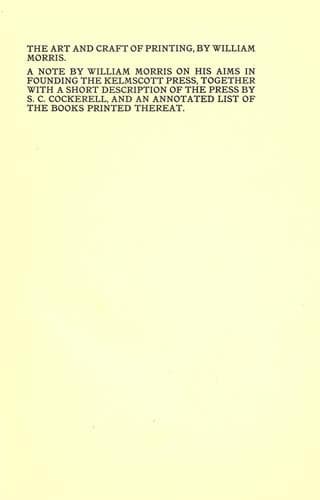
Hammersmith (London, England) -- Imprints; Kelmscott Press; Printing -- Great Britain -- History
The ornamentation of printed books is too wide a subject to be dealt
with fully here; but one thing must be said on it. The essential point
to be remembered is that the ornament, whatever it is, whether picture
or pattern-work, should form part of the page, should be a part of the
whole scheme of the book. Simple as this proposition is, it is necessary
to be stated, because the modern practice is to disregard the relation
between the printing and the ornament altogether, so that if the two are
helpful to one another it is a mere matter of accident. The due relation
of letter to pictures and other ornament was thoroughly understood by
the old printers; so that even when the woodcuts are very rude indeed,
the proportions of the page still give pleasure by the sense of richness
that the cuts and letter together convey. When, as is most often the
case, there is actual beauty in the cuts, the books so ornamented are
amongst the most delightful works of art that have ever been produced.
Therefore, granted well-designed type, due spacing of the lines and
words, and proper position of the page on the paper, all books might be
at least comely and well-looking: and if to these good qualities were
added really beautiful ornament and pictures, printed books might once
again illustrate to the full the position of our Society that a work of
utility might be also a work of art, if we cared to make it so.
* * * * *
NOTE TO THE PRESENT EDITION: The following pages showing the Troy and
Chaucer types are printed from process blocks to insure fidelity to the
originals. The frontispiece and first page of text are also reproduced
in the same manner; page one, within the border, showing the Golden
type, the only other type used by William Morris.
[Sidenote: This is the Troy type]
The following passages are given to show the Troy & Chaucer types, and
four initials that were designed for the Froissart, but never used.
The land is a little land, Sirs, too much shut up within the narrow
seas, as it seems, to have much space for swelling into hugeness:
there are no great wastes overwhelming in their dreariness, no great
solitudes of forests, no terrible untrodden mountain-walls: all is
measured, mingled, varied, gliding easily one thing into another:
little rivers, little plains, swelling, speedily-changing uplands,
all beset with handsome orderly trees; little hills, little
mountains, netted over with the walls of sheep-walks: all is little;
yet not foolish and blank, but serious rather, and abundant of
meaning for such as choose to seek it: it is neither prison, nor
palace, but a decent home.
Public-domain text, read in full here on John Shaqi.
Reviews
Reviews
No reviews yet
Be the first to share your thoughts on this work.
Join the Discussion
Join the discussion
Sign in to leave a comment or review.
Sign InorCreate an account