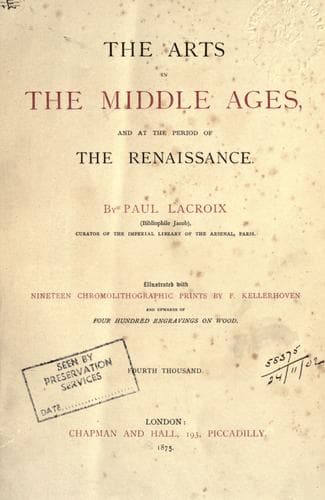
The Arts in the Middle Ages and at the Period of the RenaissanceJacob, P. L.
History
The Arts in the Middle Ages and at the Period of the Renaissance
Jacob, P. L.
Art, Medieval; Art, Renaissance; Middle Ages
The librarian Anastasius, in his book the “Lives of the Popes,” which
undoubtedly was written before the eleventh century, gives, when
describing church decorations, some curious and circumstantial details
regarding the subject we are now discussing. According to him, as early
as the time of Charlemagne (eighth century), Pope Leo III. “had a veil
made of purple worked in gold, on which was the history of the Nativity
and of Simon, having in the centre the Annunciation of the Virgin.” This
was to ornament the principal altar of the Holy Mother of God, at Rome.
He also ordered for the altar of the church of St. Laurence, “a veil of
silk worked in gold, having on it the histories of the Passion of our
Saviour and of the Resurrection.” He placed on the altar of St. Peter’s
“a veil of purple of a remarkable size, worked in gold and ornamented
with precious stones; on one side was seen our Saviour giving St. Peter
the power to bind and to loose, on the other the Passion of St. Peter
and St. Paul.” In the same book, several other pieces of tapestry are
described in such terms that it seems difficult to realise the richness
and the beauty of finish of these artistically-worked fabrics, which for
the most part came from Asia or Egypt. It was only in the twelfth
century, after the return from the first crusades had enabled Western
nations to admire and to appropriate to themselves luxuries quite new to
them, that the custom of using tapestry, while becoming far more general
in churches, found its way also into private dwellings. If, in the
cloisters, the monks, in order to find employment, lavished their utmost
care on the weaving of wool and of silk, there was the more reason why
this occupation should prove pleasing to the noble _châtelaines_ who
were confined to their feudal castles. It was then, when surrounded by
their tire-women, as in earlier times were the Roman matrons by their
slaves, that these fair dames, while listening to the reading of tales
of chivalry which deeply interested them, or inspired by a profound
faith, gave themselves to the task of reproducing with the needle either
the pious legends of the saints or the glorious exploits of warriors.
The bare walls, when thus draped with touching incidents or warlike
memorials, assumed a peculiar eloquence which doubtless inspired the
mind with grand visions, and aroused noble sentiments in the heart.
Among the finest specimens of this kind is one which, owing to its
really exquisite character, has escaped what would have seemed
inevitable destruction. We allude to the famous Bayeux tapestry called
“_de la Reine Mathilde_” (of the wife of William the Conqueror). This
work represents the conquest of England by the Normans. If we are to
accept the ancient traditions to which it owes its name, it must date
from the last half of the eleventh century.
Public-domain text, read in full here on John Shaqi.
Reviews
Reviews
No reviews yet
Be the first to share your thoughts on this work.
Elsewhere in the archive
Join the Discussion
Join the discussion
Sign in to leave a comment or review.
Sign InorCreate an account