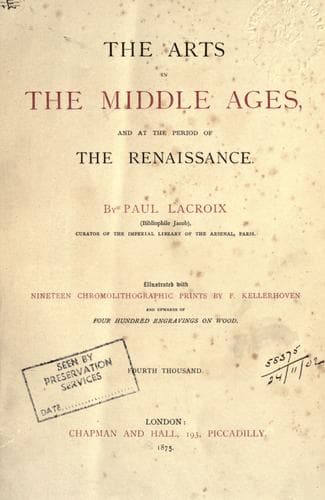
The Arts in the Middle Ages and at the Period of the RenaissanceJacob, P. L.
History
The Arts in the Middle Ages and at the Period of the Renaissance
Jacob, P. L.
Art, Medieval; Art, Renaissance; Middle Ages
of subjects therein represented. A few of these pieces of tapestry are
still preserved, but among some which have been destroyed or lost we may
mention those representing the Passion of our Saviour, the Life of St.
Denis, the Life of St. Theseus, and that entitled Goodness and
Beauty--all these were of large dimensions. Then again, the tapestry of
the Seven Mortal Sins, two pieces of the Nine Bold Knights, that of the
ladies hunting and flying (_qui volent_), in other words, hawking; that
of the Wild Men; two of Godfrey de Bouillon; a white tapestry for a
chapel, in the centre of which was seen “a compass with a rose,”
emblazoned with the arms of France and of Dauphiny, this was three yards
square; one large handsome piece of tapestry, “the king has bought,
which is worked with gold, representing the Seven Sciences and St.
Augustin;” the tapestry of Judith (the queen who subsequently appears on
playing-cards); a large piece of Arras cloth, representing the Battles
of Judas Maccabæeus and Antiochus; another of “the Battle of the Duke of
Aquitaine and of Florence;” a piece of tapestry “whereon are worked the
twelve months of the year;” another of “the Fountain of Jouvent”
(Jouvence), a large piece of tapestry “covered with azure fleurs-de-lys,
which said fleurs-de-lys are mingled with other small yellow
fleurs-de-lys, having in the centre a lion, and, at the four corners,
beasts holding banners, &c.”--in fact, the list is endless. We must
still, however, add to these figured tapestries those with armorial
bearings, made for the most part with “Arras thread,” and bearing the
arms of France and Behaigne (the latter being those of the queen,
daughter of the King of Bohemia). There was also a piece of tapestry
“worked with towers, fallow bucks and does, to put over the king’s
boat.” The tapestry called _velus_, or velvet, which now we call
_moquettes_, was as commonly seen as any other kind. There were also to
be noticed the _Salles d’Angleterre_, or the tapestries from that
country, which, as we have said, had previously acquired a great
celebrity in that art. Among these one was “_ynde_ (blue), with trees
and wild men, with wild animals, and castles;” others were vermilion,
embroidered with azure, having vignette borders, and in the centre
lions, eagles, and leopards.
In addition to these, Charles V. possessed at his castle of Melun many
“silken fabrics and tapestries.” At the Louvre one could but admire,
among other magnificent pieces of tapestry, “a very lovely green room,
ornamented with silk covered with leaves; and representing in the centre
a lion, which two queens were in the act of crowning, and a fountain
wherein swans were disporting themselves.”
Public-domain text, read in full here on John Shaqi.
Reviews
Reviews
No reviews yet
Be the first to share your thoughts on this work.
Elsewhere in the archive
Join the Discussion
Join the discussion
Sign in to leave a comment or review.
Sign InorCreate an account