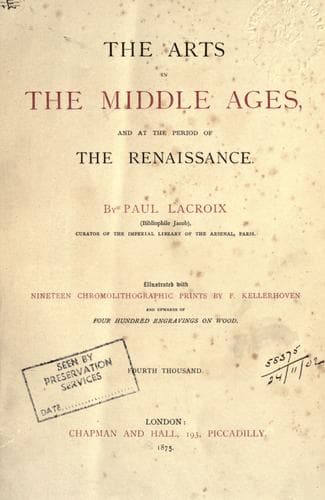
The Arts in the Middle Ages and at the Period of the RenaissanceJacob, P. L.
History
The Arts in the Middle Ages and at the Period of the Renaissance
Jacob, P. L.
Art, Medieval; Art, Renaissance; Middle Ages
Subsequently to the sixteenth century, the tapestries fabricated at the
manufactories of the Savonnerie, the Gobelins, and at Beauvais, &c.,
although more perfect as regards the weaving, and therefore presenting
greater regularity of design and a better comprehension of colour and
perspective, unfortunately lost the original simplicity which
characterized them in olden times. Approaching the reign of Louis XIV.,
under the influence of the school of Le Brun,[3] they affected an
imitation of Greek and Roman forms, which seem out of place in France.
Handsome countenances are the result, out accompanied by meaningless
figures; the frankness of truth gives place to staid coldness, the ideal
usurps the place of nature, conventionality that of spontaneity. We find
them ingenious, pretty, and even beautiful productions, but wanting
character, the real soul of works of art.
CERAMIC ART.
Pottery Workshops in the Gallo-Romano Period.--Ceramic Art
disappears for several Centuries in Gaul: is again found in the
Tenth and Eleventh Centuries.--Probable Influence of Arabian Art in
Spain.--Origin of Majolica.--Luca della Robbia and his
Successors.--Enamelled Tiles in France, dating from the Twelfth
Century.--The Italian Manufactories of Faenza, Rimini, Pesaro,
&c.--Beauvais Pottery.--Invention and Works of Bernard Palissy; his
History; his _Chefs-d’œuvre_.--The _Faïence_ of Thouars, called
“Henri II.”
We can assuredly say, with M. Jacquemart, that “the history of the
ceramic art of the Middle Ages is shrouded by a veil which probably will
always remain impenetrable. Notwithstanding the constant investigations
of local societies, and the numerous documents that have been brought to
light, nothing has transpired to remove the doubts of the archæologist
regarding the places where the manufacture of pottery had its birth
among us.”
Nevertheless, it is certain that at the Gallo-Romano period--that is to
say, when the Romans, having made themselves masters of that country,
had introduced their customs and their industry--Gaul possessed numerous
and considerable pottery workshops, which produced vessels and vases of
all kinds. Maintaining the ancient forms and processes of manufacture,
these factories continued to furnish, till about the sixth century,
amphoræ, basins, cups on stems, dishes, plates, and bottles. They were
made, with the aid of the potter’s wheel, of grey, yellow, or brown
clay. Some of the finest quality were covered with a brilliant varnish,
resembling red sealing-wax both in colour and appearance; and these
articles were often ornamented with much care and delicacy. We find
vases surrounded with garlands of leaves, cups embellished with figures
of men and animals; these are so many proofs that this was a manufacture
to which the influence of art was by no means unknown.
Public-domain text, read in full here on John Shaqi.
Reviews
Reviews
No reviews yet
Be the first to share your thoughts on this work.
Elsewhere in the archive
Join the Discussion
Join the discussion
Sign in to leave a comment or review.
Sign InorCreate an account