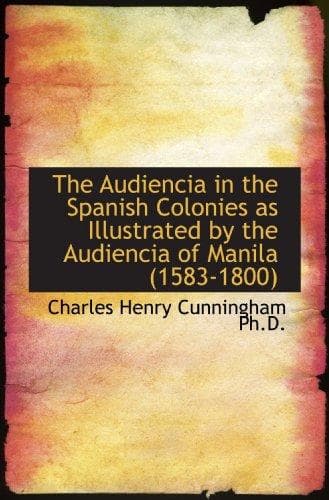
The Audiencia in the Spanish Colonies: As illustrated by the Audiencia of Manila (1583-1800)Cunningham, Charles Henry
History
The Audiencia in the Spanish Colonies: As illustrated by the Audiencia of Manila (1583-1800)
Cunningham, Charles Henry
Philippines -- History -- 1521-1812; Spain -- Colonies -- Administration
A cédula was issued on January 17, 1593, which outlined with more
definiteness a judicial system for the Islands. This reform confirmed
the position of the governor as nominal head of the judiciary, with
jurisdiction over appeals from the lower courts, but it decreed that
these cases should be tried by a letrado. The governor's final and
conclusive jurisdiction was extended to all cases not exceeding a
thousand ducats in value. Cases of a greater value might be appealed
to the Audiencia of Mexico. [99] The governor was given authority to
name a protector of the Indians. [100]
The above changes were followed shortly by the cédula of August 18,
1593, by which the title of teniente de capitán-general y asesor
de gobernador y capitán-general de las Islas Filipinas was bestowed
on Don Antonio de Morga, who was probably the most efficient jurist
and one of the most versatile officials that Spain ever sent to her
Asiatic dependency. [101] Morga was at this time not only successor
to the audiencia in judicial matters, but also attorney-general and
sole legal adviser to the governor. His predecessor, Pedro de Rojas,
was transferred to Mexico, in pursuance of the idea, as alleged in the
order of transfer, of removing from the Philippines all the members of
the old audiencia, so that the new scheme, as revised at that time,
might be allowed to work itself out without prejudice. Before his
departure, the residencia of Rojas was conducted by Morga.
Even the reforms of 1593 did not suffice to make the administration
of justice satisfactory to all parties. From the large amount of
correspondence which exists, embodying complaints against the harsh
methods of Dasmariñas and his successor, Tello, three letters may
be cited which show the attitude of the various officials of the
colony towards the re-establishment of the audiencia. The first of
these was written by Governor Dasmariñas himself, and it may be in
some ways surprising to note that he asked for the restoration of the
audiencia. His reasons, in part, however, were different from those
advanced by his contemporaries. Dasmariñas was of the opinion that an
audiencia would be effective in the nullification of the interdicts
and excommunications imposed by the archbishop and the local prelates,
which he claimed were working havoc with the civil government. [102]
Public-domain text, read in full here on John Shaqi.
Reviews
Reviews
No reviews yet
Be the first to share your thoughts on this work.
Join the Discussion
Join the discussion
Sign in to leave a comment or review.
Sign InorCreate an account