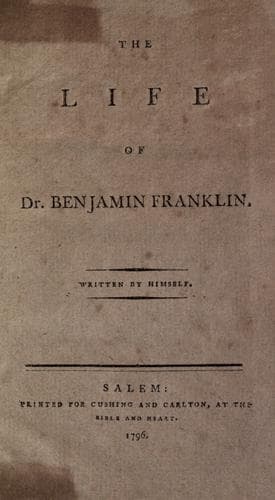
The Autobiography of Benjamin FranklinFranklin, Benjamin
ReligionComparative
The Autobiography of Benjamin Franklin
Franklin, Benjamin
Franklin, Benjamin, 1706-1790; Statesmen -- United States -- Biography
"My DEAREST SIR: When I had read over your sheets of minutes of the
principal incidents of your life, recovered for you by your Quaker
acquaintance, I told you I would send you a letter expressing my
reasons why I thought it would be useful to complete and publish it as
he desired. Various concerns have for some time past prevented this
letter being written, and I do not know whether it was worth any
expectation; happening to be at leisure, however, at present, I shall
by writing, at least interest and instruct myself; but as the terms I
am inclined to use may tend to offend a person of your manners, I shall
only tell you how I would address any other person, who was as good and
as great as yourself, but less diffident. I would say to him, Sir, I
solicit the history of your life from the following motives: Your
history is so remarkable, that if you do not give it, somebody else
will certainly give it; and perhaps so as nearly to do as much harm, as
your own management of the thing might do good. It will moreover
present a table of the internal circumstances of your country, which
will very much tend to invite to it settlers of virtuous and manly
minds. And considering the eagerness with which such information is
sought by them, and the extent of your reputation, I do not know of a
more efficacious advertisement than your biography would give. All
that has happened to you is also connected with the detail of the
manners and situation of a rising people; and in this respect I do not
think that the writings of Caesar and Tacitus can be more interesting
to a true judge of human nature and society. But these, sir, are small
reasons, in my opinion, compared with the chance which your life will
give for the forming of future great men; and in conjunction with your
Art of Virtue (which you design to publish) of improving the features
of private character, and consequently of aiding all happiness, both
public and domestic. The two works I allude to, sir, will in
particular give a noble rule and example of self-education. School and
other education constantly proceed upon false principles, and show a
clumsy apparatus pointed at a false mark; but your apparatus is simple,
and the mark a true one; and while parents and young persons are left
destitute of other just means of estimating and becoming prepared for a
reasonable course in life, your discovery that the thing is in many a
man's private power, will be invaluable! Influence upon the private
character, late in life, is not only an influence late in life, but a
weak influence. It is in youth that we plant our chief habits and
prejudices; it is in youth that we take our party as to profession,
pursuits and matrimony. In youth, therefore, the turn is given; in
youth the education even of the next generation is given; in youth the
private and public character is determined; and the term of life
extending but from youth to age, life ought to begin well from youth,
Public-domain text, read in full here on John Shaqi.
Reviews
Reviews
No reviews yet
Be the first to share your thoughts on this work.
Join the Discussion
Join the discussion
Sign in to leave a comment or review.
Sign InorCreate an account