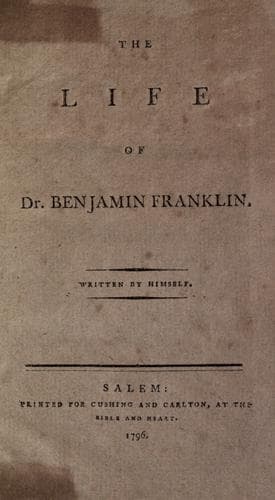
The Autobiography of Benjamin FranklinFranklin, Benjamin
ReligionComparative
The Autobiography of Benjamin Franklin
Franklin, Benjamin
Franklin, Benjamin, 1706-1790; Statesmen -- United States -- Biography
At length he took for his text that verse of the fourth chapter of
Philippians, "Finally, brethren, whatsoever things are true, honest,
just, pure, lovely, or of good report, if there be any virtue, or any
praise, think on these things." And I imagin'd, in a sermon on such a
text, we could not miss of having some morality. But he confin'd
himself to five points only, as meant by the apostle, viz.: 1. Keeping
holy the Sabbath day. 2. Being diligent in reading the holy
Scriptures. 3. Attending duly the publick worship. 4. Partaking of
the Sacrament. 5. Paying a due respect to God's ministers. These
might be all good things; but, as they were not the kind of good things
that I expected from that text, I despaired of ever meeting with them
from any other, was disgusted, and attended his preaching no more. I
had some years before compos'd a little Liturgy, or form of prayer, for
my own private use (viz., in 1728), entitled, Articles of Belief and
Acts of Religion. I return'd to the use of this, and went no more to
the public assemblies. My conduct might be blameable, but I leave it,
without attempting further to excuse it; my present purpose being to
relate facts, and not to make apologies for them.
It was about this time I conceiv'd the bold and arduous project of
arriving at moral perfection. I wish'd to live without committing any
fault at any time; I would conquer all that either natural inclination,
custom, or company might lead me into. As I knew, or thought I knew,
what was right and wrong, I did not see why I might not always do the
one and avoid the other. But I soon found I had undertaken a task of
more difficulty than I had imagined. While my care was employ'd in
guarding against one fault, I was often surprised by another; habit
took the advantage of inattention; inclination was sometimes too strong
for reason. I concluded, at length, that the mere speculative
conviction that it was our interest to be completely virtuous, was not
sufficient to prevent our slipping; and that the contrary habits must
be broken, and good ones acquired and established, before we can have
any dependence on a steady, uniform rectitude of conduct. For this
purpose I therefore contrived the following method.
Public-domain text, read in full here on John Shaqi.
Reviews
Reviews
No reviews yet
Be the first to share your thoughts on this work.
Elsewhere in the archive
Join the Discussion
Join the discussion
Sign in to leave a comment or review.
Sign InorCreate an account