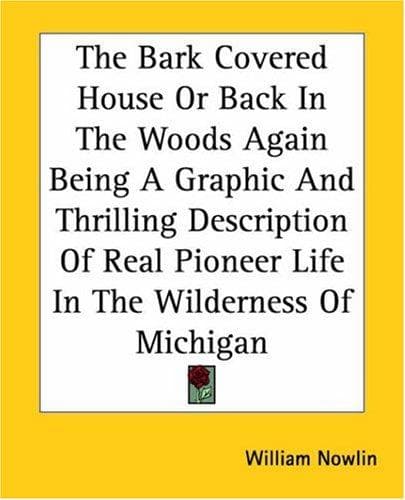
The Bark Covered House: Or, Back In the Woods Again; Being a Graphic and Thrilling Description of Real Pioneer Life in the Wilderness of MichiganNowlin, William
History
The Bark Covered House: Or, Back In the Woods Again; Being a Graphic and Thrilling Description of Real Pioneer Life in the Wilderness of Michigan
Nowlin, William
Dearborn (Mich.); Frontier and pioneer life -- Michigan -- Dearborn
The little bees had, by their unceasing industry and through their love
of gain, labored hard extracting their sweet and had laid it up
carefully. Now they pointed out their storehouse by going directly to it
when anxious eyes were watching them. The little aeronautic navigators
could be seen departing from and returning to their home. Sometimes they
went into a small hole in the side of the tree and at other times they
entered their homes by a small knot-hole in a limb near the top of the
tree. I saw that a swarm which father once found went into the tree top
more than eighty feet from the ground. At that distance they did not
appear larger than house-flies.
The first thing that father did after finding a bee-tree was to mark it
by cutting the initials of his name on the bark with his pocket-knife.
This established his title to the bees. After that they had a legal
owner. The mark on the tree was one of the witnesses. I knew a man who
happened to find a bee tree, and said that he marked it close down to
the ground and covered the mark with leaves so that no one could find
it. That appeared more sly than wise, as it gave no notice to others,
who might find the tree, of his ownership, or of its having been
previously found.
CHAPTER XIV.
OUR ROAD AND HOW I WAS WOUNDED.
Father got our road laid out and districted for a mile and a half on the
north and south section line. One mile north of our place it struck the
Dearborn road. Father cut it out, cut all the timber on the road two rods
wide. After it was cut out I could get on the top of a stump in the road,
by the side of our place, and look north carefully among the stumps, for
a minute, and if there was any one coming, on the road, I could
distinguish them from the stumps by seeing them move. In fact we thought
we were almost getting out into the world. We could see the sand hill
where father finally bought and built his house. Father was path-master
for a number of years and he crosswayed the lowest spots and across the
black ash swales. He cut logs twelve feet long and laid them side by side
across the center of the road. Some of the logs, that he put into the
road on the lowest ground, were more than a foot through; of course
smaller poles answered where the ground was higher. We called this our
corduroy road. In doing our road work and others doing theirs, year
after year, in course of time we had the log way built across the
wettest parts of the road. When it was still I could hear a cart or
wagon, coming or going, rattling and pounding over the logs for nearly a
mile. But it was so much better than water and mud that we thought it
quite passable. We threw some clay and dirt on to the logs and it made
quite an improvement, especially in a dry time. But in a wet time it was
then, and is now, a very disagreeable road to travel, as the clay gathers
on the feet of the pedestrian, until it is a load for him to carry. This
Public-domain text, read in full here on John Shaqi.
Reviews
Reviews
No reviews yet
Be the first to share your thoughts on this work.
Join the Discussion
Join the discussion
Sign in to leave a comment or review.
Sign InorCreate an account