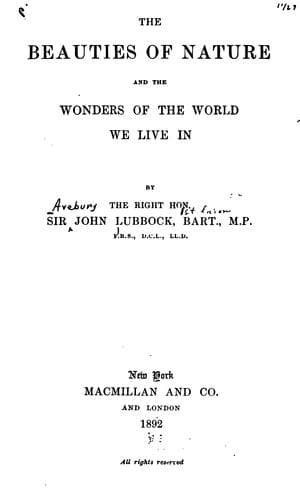
The Beauties of Nature, and the Wonders of the World We Live InLubbock, John, Sir
Philosophy
The Beauties of Nature, and the Wonders of the World We Live In
Lubbock, John, Sir
Astronomy; Natural history; Physical geography
In many of our midland and northern counties most of the meadows lie in
parallel undulations or "rigs." These are generally about a furlong (220
yards) in length, and either one or two poles (5-1/2 or 11 yards) in
breadth. They seldom run straight, but tend to curve towards the left.
At each end of the field a high bank, locally called a balk, often 3 or
4 feet high, runs at right angles to the rigs. In small fields there are
generally eight, but sometimes ten, of these rigs, which make in the one
case 4, in the other 5 acres. These curious characters carry us back to
the old tenures, and archaic cultivation of land, and to a period when
the fields were not in pasture, but were arable.
They also explain our curious system of land measurement. The "acre" is
the amount which a team of oxen were supposed to plough in a day. It
corresponds to the German "morgen" and the French "journee." The furlong
or long "furrow" is the distance which a team of oxen can plough
conveniently without stopping to rest. Oxen, as we know, were driven
not with a whip, but with a goad or pole, the most convenient length for
which was 16-1/2 feet, and the ancient ploughman used his "pole" or
"perch" by placing it at right angles to his first furrow, thus
measuring the amount he had to plough. Hence our "pole" or "perch" of
16-1/2 feet, which at first sight seems a very singular unit to have
selected. This width is also convenient both for turning the plough, and
also for sowing. Hence the most convenient unit of land for arable
purposes was a furlong in length and a perch or pole in width.
The team generally consisted of eight oxen. Few peasants, however,
possessed a whole team, several generally joining together, and dividing
the produce. Hence the number of "rigs," one for each ox. We often,
however, find ten instead of eight; one being for the parson's tithe,
the other tenth going to the ploughman.
When eight oxen were employed the goad would not of course reach the
leaders, which were guided by a man who walked on the near side. On
arriving at the end of each furrow he turned them round, and as it was
easier to pull than to push them, this gradually gave the furrow a turn
towards the left, thus accounting for the slight curvature. Lastly,
while the oxen rested on arriving at the end of the furrow, the
ploughmen scraped off the earth which had accumulated on the coulter and
ploughshare, and the accumulation of these scrapings gradually formed
the balk.
It is fascinating thus to trace indications of old customs and modes of
life, but it would carry us away from the present subject.
Even though the Swiss meadows may offer a greater variety, our English
fields are yet rich in flowers: yellow with Cowslips and Primroses, pink
with Cuckoo flowers and purple with Orchis, while, however, unwelcome to
the eye of the farmer,
the rich Buttercup
Its tiny polished urn holds up,
Filled with ripe summer to the edge,[36]
Public-domain text, read in full here on John Shaqi.
The Beauties of Nature, and the Wonders of the World We Live In — John Shaqi
Reviews
Reviews
No reviews yet
Be the first to share your thoughts on this work.
Join the Discussion
Join the discussion
Sign in to leave a comment or review.
Sign InorCreate an account