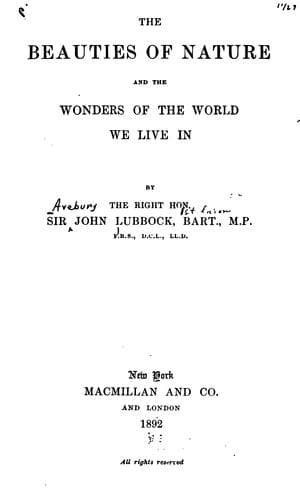
The Beauties of Nature, and the Wonders of the World We Live InLubbock, John, Sir
Philosophy
The Beauties of Nature, and the Wonders of the World We Live In
Lubbock, John, Sir
Astronomy; Natural history; Physical geography
It has been calculated that the strata between Bale and the St. Gotthard
have been compressed from 202 miles to 130 miles, the Ardennes from 50
to 25 miles, and the Appalachians from 153 miles to 65! Prof. Gumbel has
recently expressed the opinion that the main force to which the
elevation of the Alps was due acted along the main axis of elevation.
Exactly the opposite inference would seem really to follow from the
facts. If the centre of force were along the axis of elevation, the
result would, as Suess and Heim have pointed out, be to extend, not to
compress, the strata; and the folds would remain quite unaccounted for.
The suggestion of compression is on the contrary consistent with the
main features of Swiss geography. The principal axis follows a curved
line from the Maritime Alps towards the north-east by Mont Blanc and
Monte Rosa and St. Gotthard to the mountains overlooking the Engadine.
The geological strata follow the same direction. North of a line running
through Chambery, Yverdun, Neuchatel, Solothurn, and Olten to Waldshut
on the Rhine are Jurassic strata; between that line and a second nearly
parallel and running through Annecy, Vevey, Lucerne, Wesen, Appenzell,
and Bregenz on the Lake of Constance, is the lowland occupied by later
Tertiary strata; between this second line and another passing through
Albertville, St. Maurice, Lenk, Meiringen, and Altdorf lies a more or
less broken band of older Tertiary strata; south of which are a
Cretaceous zone, one of Jurassic age, then a band of crystalline rocks,
while the central core, so to say, of the Alps, as for instance at St.
Gotthard, consists mainly of gneiss or granite. The sedimentary deposits
reappear south of the Alps, and in the opinion of some high authorities,
as, for instance, of Bonney and Heim, passed continuously over the
intervening regions. The last great upheaval commenced after the Miocene
period, and continued through the Pliocene. Miocene strata attain in the
Righi a height of 6000 feet.
For neither the hills nor the mountains are everlasting, or of the same
age.
The Welsh mountains are older than the Vosges, the Vosges than the
Pyrenees, the Pyrenees than the Alps, and the Alps than the Andes, which
indeed are still rising; so that if our English mountains are less
imposing so far as mere height is concerned, they are most venerable
from their great antiquity.
Public-domain text, read in full here on John Shaqi.
Reviews
Reviews
No reviews yet
Be the first to share your thoughts on this work.
Elsewhere in the archive
Join the Discussion
Join the discussion
Sign in to leave a comment or review.
Sign InorCreate an account