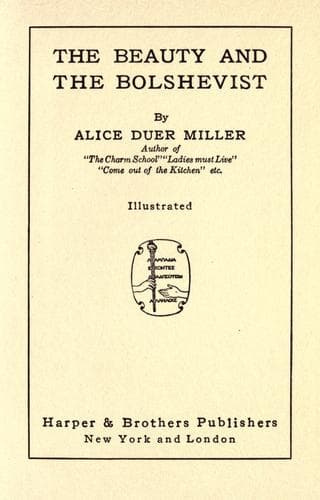
Children of the rich -- Fiction; Love stories; Newport (R.I.) -- Fiction; Socialists -- Fiction
Time—the mere knowledge of unbroken hours ahead—is a boon which real
love cannot do without. Minor feelings may flourish on snatched
interviews and stolen meetings, but love demands—and usually
gets—protected leisure. The next day these lovers had it. They spent
the morning, when Mr. Cord was known to be playing golf, at the Cords’
house, and then when Mr. Cord telephoned that he was staying to
luncheon at the club, if Crystal did not object (and Crystal did not),
she and Ben arranged a picnic—at least Tomes did, and they went off
about one o’clock in the blue car. They went to a pool in the rocks
that Crystal had always known about, with high walls around it, and
here, with a curtain of foam between them and the sea, for the waves
were rising, they ate lunch, as much alone as on a desert island.
It was here that Ben asked her to marry him, or, to be accurate, it was
here that they first began talking about their life together, and
whether Nora would become reconciled to another woman about the flat.
The nearest approach to a definite proposal was Ben’s saying:
“You would not mind my saying something about all this to your father
before I go this evening, would you?”
And Crystal replied: “Poor father! It will be a blow, I’m afraid.”
“Well,” said Ben, “he told me himself that he liked me better than
David.”
“That’s not saying much.”
At this Ben laughed lightly.
He might have had his wrong-headed notions about barriers, but he was
not so un-American as to regard a father as an obstacle.
“But, oh, Crystal,” he added, “suppose you find you do hate being poor.
It is a bore in some ways.”
Crystal, who had been tucking away the complicated dishes of her
luncheon basket, looked at Ben and lightly sucked one finger to which
some raspberry jam from Tomes’s supernal sandwiches had adhered.
“I sha’n’t mind it a bit, Ben,” she said, “and for a good
reason—because I’m terribly conceited.” He did not understand at all,
and she went on: “I believe I shall be just as much of a person—perhaps
more—without money. The women who really mind being poor are the
humble-minded ones, who think that they are made by their clothes and
their lovely houses and their maids and their sables. When they lose
them they lose all their personality, and of course that terrifies
them. I don’t think I shall lose mine. Does it shock you to know that I
think such a lot of myself?”
It appeared it did not shock him at all.
[Illustration: “Suppose You Find You Do Hate Being Poor?”]
When they reached the house she established him in the drawing-room and
went off to find her father.
Public-domain text, read in full here on John Shaqi.
Reviews
Reviews
No reviews yet
Be the first to share your thoughts on this work.
Elsewhere in the archive
Join the Discussion
Join the discussion
Sign in to leave a comment or review.
Sign InorCreate an account