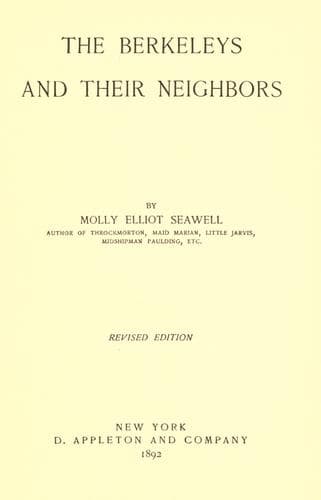
The Berkeleys and their neighborsSeawell, Molly Elliot
General
The Berkeleys and their neighbors
Seawell, Molly Elliot
Virginia -- Fiction
Anything that occurred in ’forty-six had such a charm for Colonel
Berkeley that Miles knew he was in for it. The Colonel took his arm and
trotted up and down the portico, pointing out various ways in which
the late Mr. Pembroke, his devoted friend, had neglected the Colonel’s
advice in regard to farming, and the numberless evils that had resulted
therefrom. Colonel Berkeley entirely forgot that his own farming was
not above reproach, and if he had been reduced to his land for a
living, instead of that lucky property at the North that he had so
strenuously tried to make way with, he would indeed have been in a bad
way. But the Colonel was a famous farmer on paper, was president of the
Farmers’ Club of the county, had published several pamphlets on subsoil
drainage, and was a frequent contributor to the columns of the Southern
Planter before the war.
Cave and Olivia, finding themselves temporarily thrown on each other,
concluded to walk through the grounds. Madame Koller and her mother had
not yet arrived, and under the huge trees, a little distance off, they
could see Pembroke talking with his visitor, as the latter mounted his
horse to ride away.
In former days the grounds, like the house, had been fine, but now
they were completely overgrown and neglected, yet, there was a kind of
beauty in their very wildness.
“How charming this wilderness of roses will be when they are in
bloom,” said Olivia, as they walked through what had once been a rose
walk, stiff and prim, now rioting in lush luxuriance. “I remember it
quite straight, and the rose trees trimmed up all in exactly the same
shape--and see, the roses have climbed so over the arbor that we can’t
get in.”
Cave said nothing. The one love of his life was born and lived and died
in this home. He could see, through a rift in the trees, the brick
wall around the burying ground where Elizabeth lay. It was fallen away
in many places, and the sheep browsed peacefully over the mounds. The
marble slab over Elizabeth was as yet new and white. Still Olivia did
not jar on him at that moment. She was innately sympathetic.
They paced slowly about the graveled paths overgrown in many places
with weeds, and among a vigorous growth of young shrubbery, unpruned
and unclipped. She pulled a great branch of pink dogwood from a
transplanted forest tree, and swayed it thoughtfully as she walked.
Presently they saw Pembroke coming to look for them. As he approached
and took Olivia’s hand, a color as delicate as that of the dogwood
blossoms she held in her other hand, mounted to her face.
Then they turned back leisurely toward the house. At one spot, under a
great linden tree, was the basin of a fountain, all yellow and choked
with the trailing arbutus, which grew with the wild profusion that
marks it in the depth of the woods. The fountain was long since gone.
Pembroke plucked some of the arbutus and handed it to Olivia, taking
from her the dogwood branch at the same time and throwing it away.
Public-domain text, read in full here on John Shaqi.
Reviews
Reviews
No reviews yet
Be the first to share your thoughts on this work.
Elsewhere in the archive
Join the Discussion
Join the discussion
Sign in to leave a comment or review.
Sign InorCreate an account