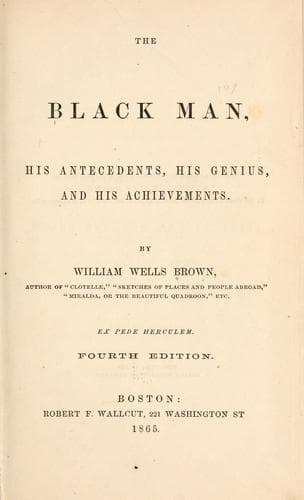
The Black Man: His Antecedents, His Genius, and His AchievementsBrown, William Wells
History
The Black Man: His Antecedents, His Genius, and His Achievements
Brown, William Wells
African Americans -- Biography
Hewell, the greater part of whose life had been spent on the plantation
in the capacity of a negro-driver, and who knew that the defiant looks
of these men meant something, was the first to start. Drawing his old
horse pistol from under his coat, he fired at one of the blacks and
killed him. The next moment Hewell lay dead upon the deck, for Madison
had struck him with a capstan bar. The fight now became general, the
white passengers, as well as all the crew, taking part. The battle
was Madison's element, and he plunged into it without any care for
his own preservation or safety. He was an instrument of enthusiasm,
whose value and whose place was in his inspiration. "If the fire of
heaven was in my hands, I would throw it at these cowardly whites,"
said he to his companions, before leaving their cabin. But in this he
did not mean revenge, only the possession of his freedom and that of
his fellow-slaves. Merritt and Gifford, the first and second mates of
the vessel, both attacked the heroic slave at the same time. Both were
stretched out upon the deck with a single blow each, but were merely
wounded; they were disabled, and that was all that Madison cared for
for the time being. The sailors ran up the rigging for safety, and a
moment more he that had worn the fetters an hour before was master of
the brig Creole. His commanding attitude and daring orders, now that
he was free, and his perfect preparation for the grand alternative of
liberty or death which stood before him, are splendid exemplifications
of the truly heroic. After his accomplices had covered the slaver's
deck, Madison forbade the shedding of more blood, and ordered the
sailors to come down, which they did, and with his own hands he dressed
their wounds. A guard was placed over all except Merritt, who was
retained to navigate the vessel. With a musket doubly charged, and
pointed at Merritt's breast, the slave made him swear that he would
faithfully take the brig into a British port. All things now secure,
and the white men in chains or under guard, Madison ordered that the
fetters should be severed from the limbs of those slaves who still
wore them. The next morning "Captain Washington" (for such was the
name he now bore) ordered the cook to provide the best breakfast that
the store room could furnish, intending to surprise his fellow-slaves,
and especially the females, whom he had not yet seen. But little did
he think that the woman for whom he had risked his liberty and life
would meet him at the breakfast table. The meeting of the hero and his
beautiful and accomplished wife, the tears of joy shed, and the hurrahs
that followed from the men, can better be imagined than described.
Madison's cup of joy was filled to the brim. He had not only gained his
own liberty and that of one hundred and thirty-four others, but his
dear Susan was safe. Only one man, Hewell, had been killed. Captain
Enson and others, who were wounded, soon recovered; and were kindly
Public-domain text, read in full here on John Shaqi.
Reviews
Reviews
No reviews yet
Be the first to share your thoughts on this work.
Elsewhere in the archive
Join the Discussion
Join the discussion
Sign in to leave a comment or review.
Sign InorCreate an account