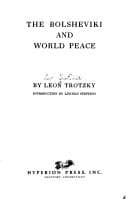
Communism -- Soviet Union; Europe -- Social conditions -- 20th century; Socialism; World War, 1914-1918
What at first glance appears the most surprising thing about it all is,
that the Social Democracy had not really felt the need for a political
criterion. In the catastrophe that has occurred to the International
the arguments have been notable for their superficiality. They
contradicted each other, shifted ground, and were of only secondary
significance--the gist of the matter being that the _fatherland must be
defended_. Apart from considerations of the historical outcome of the
War, apart from considerations of democracy and the class struggle, the
fatherland that has come down to us historically must be defended. And
defended not because our government wanted peace and was "perfidiously
attacked," as the international penny-a-liners put it, but because apart
from the conditions or the ways in which it was provoked, apart from who
was right and who was wrong, war, once it breaks out, subjects every
belligerent to the danger of invasion and conquest. Theoretical,
political, diplomatic and military considerations fall into ruins as in
an earthquake, a conflagration or a flood. The government with its army
is elevated to the position of the one power that can protect and save
its people. The large masses of the people in actuality return to a
pre-political condition. This feeling of the masses, this elemental
reflex of the catastrophe, need not be criticized in so far as it is
only a temporary feeling. But it is quite a different matter in the
case of the attitude of the Social Democracy, the responsible political
representative of the masses. The political organizations of the
possessing classes and especially the power of the government itself did
not simply float with the stream. They instantly set to work most
intensively and in very varied ways to heighten this unpolitical
sentiment and to unite the masses around the army and the government.
The Social Democracy not only did not become equally active in the
opposite direction, but from the very first moment surrendered to the
policy of the government and to the elemental feeling of the masses.
And instead of arming these masses with the weapons of criticism and
distrust, if only passive criticism and distrust, it itself by its whole
attitude hastened the people along the road to this pre-political
condition. It renounced its traditions and political pledges of fifty
years with a conspicuous readiness that was least of all calculated to
inspire the rulers with respect.
Public-domain text, read in full here on John Shaqi.
Reviews
Reviews
No reviews yet
Be the first to share your thoughts on this work.
Join the Discussion
Join the discussion
Sign in to leave a comment or review.
Sign InorCreate an account