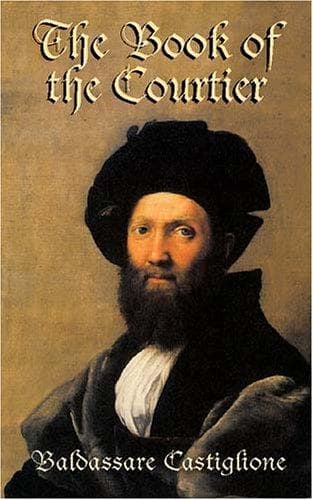
The Book of the CourtierCastiglione, Baldassarre, conte
History
The Book of the Courtier
Castiglione, Baldassarre, conte
Courtesy -- Early works to 1800; Courts and courtiers -- Early works to 1800
“Therefore I think that whoever wishes to avoid all doubt and be quite
safe, must needs select as model someone who by consent of all is rated
good, and must take him as a constant guide and shield against any
possible adverse critic. And this model (in the vernacular, I mean) I do
not think should be other than Petrarch[79] and Boccaccio; and whoever
departs from these two, gropes like one who walks in the dark without a
light and thus often mistakes the road. But we are so daring that we do
not deign to do that which the good writers of old did,—that is, devote
themselves to imitation, without which I think a man cannot write
well.[80] And methinks good proof of this is shown us by Virgil, who by
his genius and judgment so divine took from all posterity the hope of
ever being able to imitate him well, yet fain would imitate Homer.”
31.—Then my lord Gaspar Pallavicino said:
“This discussion about writing is certainly well worth listening to:
still it would be more to our purpose if you were to teach us in what
manner the Courtier ought to speak, for I think he has greater need of
it and more often has occasion to employ speaking than writing.”
The Magnifico replied:
“Nay, for a Courtier so excellent and so perfect there is no doubt but
it is necessary to know both the one and the other, and that without
these two accomplishments perhaps all the rest would not be very worthy
of praise. So if the Count wishes to perform his duty, he will teach the
Courtier not only how to speak, but also how to write well.”
Then the Count said:
“My lord Magnifico, that task I will on no account accept; for great
folly would be mine to pretend to teach others that which I do not
myself know, and (even if I did know it) to think myself able to do in
only a few words that which with so much care and pains has hardly been
done by most learned men,—to whose works I should refer our Courtier, if
I were indeed bound to teach him how to write and speak.”
Messer Cesare said:
“My lord Magnifico means speaking and writing the vernacular [Italian],
and not Latin; so those works by learned men are not to our purpose. But
in this matter there is need for you to tell us what you know about it,
because for the rest we will hold you excused.”
The Count replied:
“I have told you that already; but as we are speaking of the Tuscan
tongue, perhaps it would be, more than any other man’s, my lord
Magnifico’s office to give an opinion on it.”
The Magnifico said:
“I cannot and in reason ought not to contradict any man who says that
the Tuscan tongue is more beautiful than the others.[81] It is very true
that in Petrarch and in Boccaccio are found many words that are now
discarded by the custom of to-day; and these I for my part would never
use either in speaking or in writing; and I believe that they
themselves, if they had survived until now, would no longer use those
words.”
Then messer Federico said:
Public-domain text, read in full here on John Shaqi.
Reviews
Reviews
No reviews yet
Be the first to share your thoughts on this work.
Elsewhere in the archive
Join the Discussion
Join the discussion
Sign in to leave a comment or review.
Sign InorCreate an account