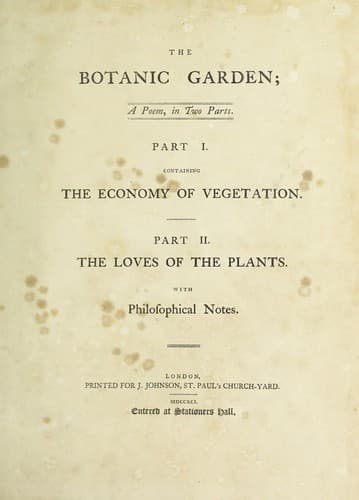
The Botanic Garden. Part 2, Containing the Loves of the Plants. A Poem.: With Philosophical Notes.Darwin, Erasmus
History
The Botanic Garden. Part 2, Containing the Loves of the Plants. A Poem.: With Philosophical Notes.
Darwin, Erasmus
Natural history; Plants -- Poetry
Inlays the broider'd weft with flowery dyes,
70 Quick beat the reeds, the pedals fall and rise;
Slow from the beam the lengths of warp unwind,
And dance and nod the massy weights behind.--
Taught by her labours, from the fertile soil
Immortal Isis clothed the banks of Nile;
75 And fair ARACHNE with her rival loom
Found undeserved a melancholy doom.--
_Five_ Sister-nymphs with dewy fingers twine
The beamy flax, and stretch the fibre-line;
Quick eddying threads from rapid spindles reel,
80 Or whirl with beaten foot the dizzy wheel.
--Charm'd round the busy Fair _five_ shepherds press,
Praise the nice texture of their snowy dress,
Admire the Artists, and the art approve,
And tell with honey'd words the tale of love.
85 So now, where Derwent rolls his dusky floods
Through vaulted mountains, and a night of woods,
The Nymph, GOSSYPIA, treads the velvet sod,
And warms with rosy smiles the watery God;
His ponderous oars to slender spindles turns,
90 And pours o'er massy wheels his foamy urns;
With playful charms her hoary lover wins,
And wields his trident,--while the Monarch spins.
--First with nice eye emerging Naiads cull
From leathery pods the vegetable wool;
[_Gossypia_. l. 87. Gossypium. The cotton plant. On the river Derwent near
Matlock in Derbyshire, Sir RICHARD ARKWRIGHT has created his curious
and magnificent machinery for spinning cotton; which had been in vain
attempted by many ingenious artists before him. The cotton-wool is first
picked from the pods and seeds by women. It is then carded by _cylindrical
cards_, which move against each other, with different velocities. It is
taken from these by an _iron-hand_ or comb, which has a motion similar to
that of scratching, and takes the wool off the cards longitudinally in
respect to the fibres or staple, producing a continued line loosely
cohering, called the _Rove_ or _Roving_. This Rove, yet very loosely
twisted, is then received or drawn into a _whirling canister_, and is
rolled by the centrifugal force in spiral lines within it; being yet too
tender for the spindle. It is then passed between _two pairs of rollers_;
the second pair moving faster than the first elongate the thread with
greater equality than can be done by the hand; and is then twisted on
spoles or bobbins.
Public-domain text, read in full here on John Shaqi.
Reviews
Reviews
No reviews yet
Be the first to share your thoughts on this work.
Join the Discussion
Join the discussion
Sign in to leave a comment or review.
Sign InorCreate an account