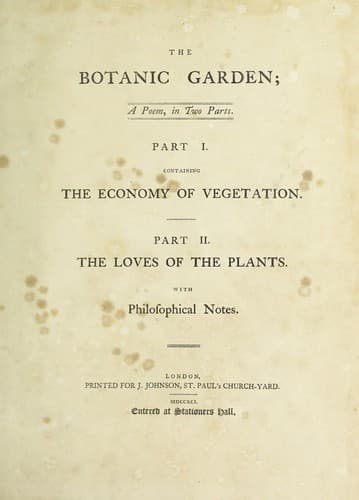
The Botanic Garden. Part 2, Containing the Loves of the Plants. A Poem.: With Philosophical Notes.Darwin, Erasmus
History
The Botanic Garden. Part 2, Containing the Loves of the Plants. A Poem.: With Philosophical Notes.
Darwin, Erasmus
Natural history; Plants -- Poetry
[_So now Delany_. l. 155. Mrs. Delany has finished nine hundred and
seventy accurate and elegant representations of different vegetables
with the parts of their flowers, fructification, &c. according with the
classification of Linneus, in what she terms paper-mosaic. She began this
work at the age of 74, when her sight would no longer serve her to paint,
in which she much excelled; between her age of 74 and 82, at which time
her eyes quite failed her, she executed the curious Hortus ficcus
above-mentioned, which I suppose contains a greater number of plants
than were ever before drawn from the life by any one person. Her method
consisted in placing the leaves of each plant with the petals, and all
the other parts of the flowers, on coloured paper, and cutting them with
scissars accurately to the natural size and form, and then parting them
on a dark ground; the effect of which is wonderful, and their accuracy
less liable to fallacy than drawings. She is at this time (1788) in her
89th year, with all the powers of a fine understanding still unimpaired.
I am informed another very ingenious lady, Mrs. North, is constructing a
similar Hortus ficcus, or Paper-garden; which she executes on a ground of
vellum with such elegant taste and scientific accuracy, that it cannot
fail to become a work of inestimable value.]
Her virgin train the tender scissars ply,
Vein the green leaf, the purple petal dye:
Round wiry stems the flaxen tendril bends,
160 Moss creeps below, and waxen fruit impends.
Cold Winter views amid his realms of snow
DELANY'S vegetable statues blow;
Smooths his stern brow, delays his hoary wing,
And eyes with wonder all the blooms of spring.
165 The gentle LAPSANA, NYMPHÆA fair,
And bright CALENDULA with golden hair,
[_Lapsana, Nymphæa alba, Calendula_. l. 165. And many other flowers close
and open their petals at certain hours of the day; and thus constitute
what Linneus calls the Horologe, or Watch of Flora. He enumerates 46
flowers, which possess this kind of sensibility. I shall mention a few of
them with their respective hours of rising and setting, as Linneus terms
them. He divides them first into _meteoric_ flowers, which less accurately
observe the hour of unfolding, but are expanded sooner or later, according
to the cloudiness, moisture, or pressure of the atmosphere. 2d. _Tropical_
flowers open in the morning and close before evening every day; but the
hour of the expanding becomes earlier or later, at the length of the day
increases or decreases. 3dly. _Æquinoctial_ flowers, which open at a
certain and exact hour of the day, and for the most part close at another
determinate hour.
Public-domain text, read in full here on John Shaqi.
Reviews
Reviews
No reviews yet
Be the first to share your thoughts on this work.
Join the Discussion
Join the discussion
Sign in to leave a comment or review.
Sign InorCreate an account