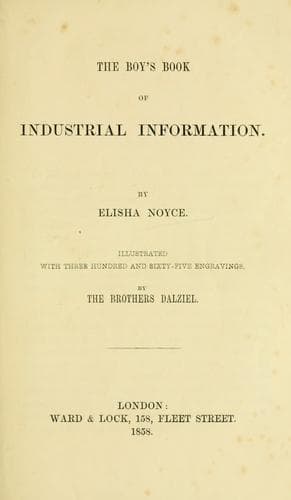
The Boy's Book of Industrial InformationNoyce, Elisha
General
The Boy's Book of Industrial Information
Noyce, Elisha
Industrial arts -- Juvenile literature; Technology -- Juvenile literature
Chocolate and cocoa are made from the seeds or beans of the
_Theobroma Cacao_. The fruit of this plant somewhat resembles a
cucumber, and contains from twenty to thirty seeds; these are dried
and packed for the market. They come to this country from the West
Indies (Berbice and Demerara). The beans are roasted in an iron
cylinder with holes to let out the vapour, &c.; when cool they are
deprived of their husks, and then crushed by means of rollers turning
on a flat slab, kept warm by stoves or steam. The seeds when crushed
on the warm slab become almost liquid, owing to a kind of butter or
concrete oil which they contain, and which melts by a gentle heat.
When the seeds are rolled by the machine into a smooth paste, this
is either put into a mould of tin and formed into squares and various
other forms, or left rough as it is scraped from the slab (this
is called “rock” cocoa). For chocolate it is mixed with sugar, and
either dried and powdered, or made, as the cocoa, into paste. On the
Continent it is flavoured with “vanilla.”
STEEL.
Illustration: BESSEMER’S PROCESS.
Steel is usually made by a process called “cementation.” Bars of the
best Swedish or Russian iron, about six feet long, are placed in an
iron box, the bottom of which is covered with a layer of charcoal
powder; over the first row of iron bars some more charcoal is put,
and then another row of iron bars, and so on till the box is full,
when it is carefully closed and kept at a white heat for four or
five days. When cold, the bars are found to be converted into steel,
and, being rough and blistered on the surface, are called “blistered
steel;” this is broken up, and the bars laid side by side and made
hot in a forge, where they are welded together by the blows of a
heavy hammer, and drawn or rolled out by machinery into bars of
“fine steel.” Steel differs from iron in the closeness of its grain,
in being very much “tougher,” and in having that very useful and
peculiar property called “temper,” which is the power of hardening
when suddenly cooled while red-hot. If a bar of steel as soft as
iron be made of a bright red heat, and then suddenly plunged into
cold water, it will be found to have become harder than any other
metal (so hard, indeed, that it will scratch glass), and is as
brittle and readily broken as flint or glass. If now a gentle heat
be applied to it, this extreme hardness of temper gives way. For
instance, if a piece of bright hard steel is held for a moment in
the hollow of a clear fire, a pale straw color appears on its surface,
it is now still very hard (but not so hard as before), and is fit
for razors, surgeons’ instruments, &c; but if held in the fire a
moment or two longer, it becomes of a bright golden yellow, and is
fit for penknives, and other cutting instruments; held longer still,
it becomes bright blue, and is fit for watch-springs, swords, and
other purposes requiring great elasticity but no great hardness; if
Public-domain text, read in full here on John Shaqi.
Reviews
Reviews
No reviews yet
Be the first to share your thoughts on this work.
Elsewhere in the archive
Join the Discussion
Join the discussion
Sign in to leave a comment or review.
Sign InorCreate an account