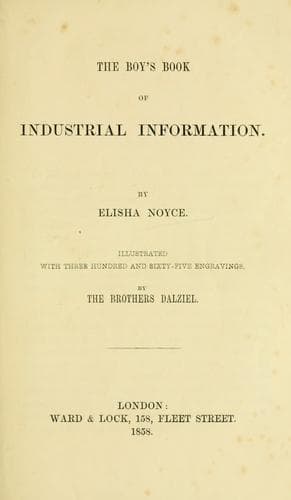
The Boy's Book of Industrial InformationNoyce, Elisha
General
The Boy's Book of Industrial Information
Noyce, Elisha
Industrial arts -- Juvenile literature; Technology -- Juvenile literature
Copper and brass vessels are tinned inside, to prevent the formation
of that poisonous substance called verdigris. The mode of tinning
them is as follows:--They are cleaned inside by means of vitriol, and
then made hot, fine grain-tin and a little rosin being put into them,
and turned about and brushed over the surface with a ball of tow: by
this means, the tin is equally spread over the inner surface of the
vessel.
Tin-tacks, buckles, and other small articles, receive a coating of
tin by being put into an earthen pot together with some grain-tin
and a substance called “sal ammoniac,” and the pot being heated
over a fire sufficiently to melt the tin, is then shaken up till
the articles inside have received a coating of tin.
Iron plates have lately been coated with melted zinc instead of tin,
and the surface thus covered enables them to be used for various
purposes and in situations where they are exposed to the action
of the weather, as on housetops, &c. The plates, thus treated, are
called “galvanised iron,” and they are generally used in a corrugated
form. They withstand the action of the weather very much better than
simple iron plates would, for the latter would be very soon eaten
into holes from rusting.
GLASS.
This most useful and elegant material--now an article of almost
universal application, in various forms--is made on a very large
scale by fusing together sea-sand and alkali (either potash, soda,
or lime), and, in the case of “crystal,” or “flint-glass,” oxide of
lead. The following is about the composition of the chief kinds of
glass in use:--
FLINT GLASS. PARTS. PLATE GLASS. PARTS.
Pure white sea-sand 52 Pure white sand 55
Potash 14 Soda 35
Oxide of lead 34 Nitre 8
------ Lime 2
100 -----
100
CROWN GLASS. PARTS. GREEN BOTTLE GLASS. PARTS.
Fine white sand 63 Sea-sand 80
Chalk 7 Salt 10
Soda 30 Lime 10
---- ----
100 100
Public-domain text, read in full here on John Shaqi.
Reviews
Reviews
No reviews yet
Be the first to share your thoughts on this work.
Elsewhere in the archive
Join the Discussion
Join the discussion
Sign in to leave a comment or review.
Sign InorCreate an account