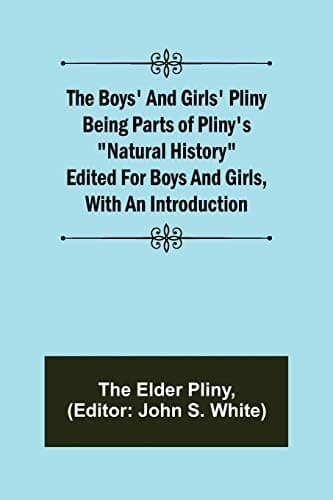
The Boys' and Girls' Pliny: Being parts of Pliny's "Natural History" edited for boys and girls, with an IntroductionPliny, the Elder
History
The Boys' and Girls' Pliny: Being parts of Pliny's "Natural History" edited for boys and girls, with an Introduction
Pliny, the Elder
Animals -- Juvenile literature; Natural history -- Juvenile literature; Physical sciences -- Juvenile literature
There is a tribe of Æthiopian Nomades dwelling on the banks of the river
Astragus, towards the north, and about twenty days’ journey from the
ocean. These people are called Menismini; they live on the milk of the
animal which we call cynocephalus,[68] and rear large flocks of these
creatures. In the deserts of Africa, men are frequently seen to all
appearance, and then vanish in an instant.
Nature, in her ingenuity, has created all these marvels in the human
race, with others of a similar nature, as so many amusements to herself,
though they appear miraculous to us. But who is there that can enumerate
all the things that she brings to pass each day, I may almost say each
hour? As a striking evidence of her power, let it be sufficient for me
to have cited whole nations in the list of her prodigies.
Let us now proceed to mention some other particulars connected with Man,
the truth of which is universally admitted.
It is a subject for pity, and even for a feeling of shame, when one
reflects that the origin and life of the most vain of all animated
beings is so frail: Thou man, who placest thy confidence in the strength
of thy body, thou, who dost embrace the gifts of Fortune, and look upon
thyself, not only as her fosterling, but even as her own born child,
thou, whose mind is ever thirsting for blood, thou who, puffed up with
some success or other, dost think thyself a god—by how trifling a thing
might thy life have been cut short! Even this very day, something still
less even may have the same effect, the puncture, for instance, of the
tiny sting of the serpent; or even, as befell the poet Anacreon, the
swallowing of the stone of a raisin, or of a single hair in a draught of
milk, by which the prætor and senator, Fabius, was choked, and so met
his death. He only, in fact, will be able to form a just estimate of the
value of life, who will always bear in mind the extreme frailty of its
tenure.
CHAPTER III.
INSTANCES OF EXTRAORDINARY STRENGTH.
Public-domain text, read in full here on John Shaqi.
Reviews
Reviews
No reviews yet
Be the first to share your thoughts on this work.
Join the Discussion
Join the discussion
Sign in to leave a comment or review.
Sign InorCreate an account