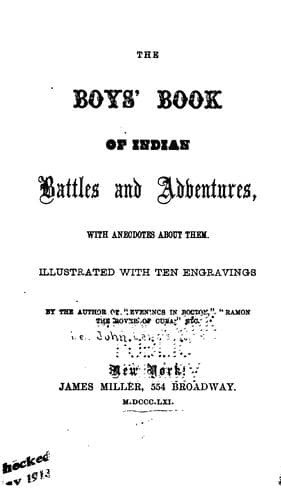
The boys' book of Indian battles and adventures, with anecdotes about them
History
The boys' book of Indian battles and adventures, with anecdotes about them
Indians of North America -- Anecdotes
The peace which had subsisted since the marriage of Pocahontas had lulled
the English into security, and disposed them to extend their plantations
along the banks of the rivers, as far as the Potomac, in situations too
remote from each other. Their houses were open and free to the natives,
who became acquainted with their manner of living, their hours of eating,
of labor and repose, the use of their arms and tools, and frequently
borrowed their boats, for the convenience of fishing and fowling, and
to pass the rivers. This familiarity was pleasing to the English, as it
indicated a spirit of moderation, which had been always recommended, by
the Company in England, to the planters; and, as it afforded a favourable
symptom of the civilization and conversion of the natives; but by
them, or their leaders, it was designed to conceal the most sanguinary
intentions.
In the spring of the next year, (1622) an opportunity offered, to
throw off the mask of friendship, and kindle their secret enmity into
a blaze. Among the natives who frequently visited the English, was a
tall, handsome, young chief, renowned for courage and success in war,
and excessively fond of finery in dress. His Indian name was Nematanow;
but by the English he was called Jack of the Feather. Coming to the
store of one Morgan, he there viewed several toys and ornaments, which
were very agreeable to the Indian taste; and persuaded Morgan to carry
them to Pamunky, where he assured him of an advantageous traffic. Morgan
consented to go with him; but was murdered by the way.
In a few days, Nematanow came again to the store, with Morgan’s cap on
his head; and being interrogated by two stout lads, who attended there,
what was become of their master, he answered that he was dead. The boys
seized him, and endeavoured to carry him before a magistrate; but his
violent resistance, and the insolence of his language, so provoked them,
that they shot him. The wound proved mortal; and when dying, he earnestly
requested of the boys, that the manner of his death might be concealed
from his countrymen, and that he might be privately buried among the
English.
Public-domain text, read in full here on John Shaqi.
Reviews
Reviews
No reviews yet
Be the first to share your thoughts on this work.
Elsewhere in the archive
Join the Discussion
Join the discussion
Sign in to leave a comment or review.
Sign InorCreate an account