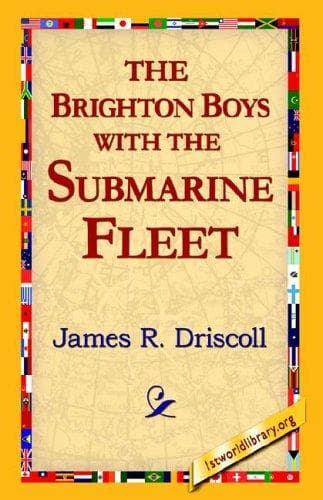
The Brighton Boys with the Submarine FleetDriscoll, James R.
General
The Brighton Boys with the Submarine Fleet
Driscoll, James R.
Submarines (Ships) -- Juvenile fiction; World War, 1914-1918 -- Naval operations -- Juvenile fiction
For some moments the boys discussed the predicament of the _Dewey_,
the unfortunate circumstances that had led her aground, and the
possibilities of being floated again. Jack confided to his chum the
fact that he had overheard Lieutenant McClure say the _Dewey_ probably
had ventured too close in shore and had run afoul of a sand bar.
"What's the next move?" queried Ted.
"You've got me, chum; I don't know what they will try next," answered
Jack, feeling a bit glum despite his natural cheerfulness.
Lieutenant McClure and his officers---Cleary, Binns, and Blaine---were
now making an inspection of the _Dewey_ fore and aft. As they returned
amidships the boys overheard snatches of the conversation.
"Propeller blades free, aren't they?" McClure was asking.
"Working free and easy or else the shafts wouldn't turn," Blaine
was saying.
From what the boys could gather from the conversation it was the
belief of the ship's officers that the _Dewey_ was grounded on a
heavy sand bar. She had sloughed down deep in the miry sea bottom
with her keel amidships firmly imbedded and her bow and stern floating
free. The suction of the mud prevented her from rising.
In the wireless room Jack, Ted, Sammy Smith and Bill Witt finally came
together and began speculating on the critical predicament of their
ship. Cooped up in their cage of steel, shut off from the outside
world of fresh air and sunshine, the crew of the _Dewey_ were held
prisoners like rats in a trap, dependent for life upon the air they
were breathing and the precious stores of oxygen in the emergency
tanks!
The next few hours were full of anxiety for the officers and crew of
the stranded _Dewey_. Several times during the morning the ship's
engines were set in motion and valiant efforts made to drag the ship
off the shoal. But each succeeding effort availed nothing, except
to eat up the precious electrical energy in the storage batteries.
In the petrol tanks was plenty of fuel for the engines, but it was
useless here on the bottom of the sea where only the electric motors
could be used in submerged locomotion.
Realizing the futility of these sporadic efforts at escape, Lieutenant
McClure decided to wait until one o'clock for another supreme effort.
It would be high tide at noon and he decided to make the great effort
shortly thereafter on the thin hope that he might get away with the
tide running out to sea.
The time passed drearily. Jack and Ted tried to get interested in a
game of chess, but with little success. Bill Witt sought with mouth
organ and banjo to buoy up the spirits of his downcast mates and
succeeded poorly. Noon mess was served at eleven forty-five and
even Jean Cartier, as he dispensed canned beans, brown bread, stewed
fruit and tea, forgot to smile as usual at his culinary tasks.
Public-domain text, read in full here on John Shaqi.
Reviews
Reviews
No reviews yet
Be the first to share your thoughts on this work.
Join the Discussion
Join the discussion
Sign in to leave a comment or review.
Sign InorCreate an account