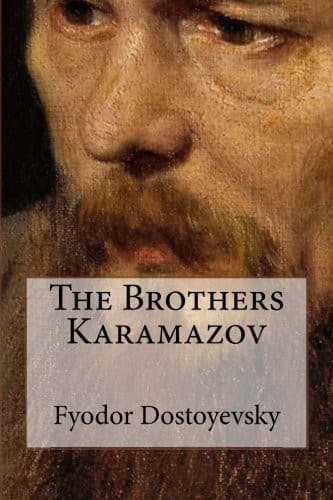
Brothers -- Fiction; Didactic fiction; Fathers and sons -- Fiction; Russia -- Social life and customs -- 1533-1917 -- Fiction
Although Fyodor Pavlovitch was taken unawares, he was equal to the
occasion. In response to Dmitri’s bow he jumped up from his chair and
made his son a bow as low in return. His face was suddenly solemn and
impressive, which gave him a positively malignant look. Dmitri bowed
generally to all present, and without a word walked to the window with
his long, resolute stride, sat down on the only empty chair, near
Father Païssy, and, bending forward, prepared to listen to the
conversation he had interrupted.
Dmitri’s entrance had taken no more than two minutes, and the
conversation was resumed. But this time Miüsov thought it unnecessary
to reply to Father Païssy’s persistent and almost irritable question.
“Allow me to withdraw from this discussion,” he observed with a certain
well-bred nonchalance. “It’s a subtle question, too. Here Ivan
Fyodorovitch is smiling at us. He must have something interesting to
say about that also. Ask him.”
“Nothing special, except one little remark,” Ivan replied at once.
“European Liberals in general, and even our liberal dilettanti, often
mix up the final results of socialism with those of Christianity. This
wild notion is, of course, a characteristic feature. But it’s not only
Liberals and dilettanti who mix up socialism and Christianity, but, in
many cases, it appears, the police—the foreign police, of course—do the
same. Your Paris anecdote is rather to the point, Pyotr
Alexandrovitch.”
“I ask your permission to drop this subject altogether,” Miüsov
repeated. “I will tell you instead, gentlemen, another interesting and
rather characteristic anecdote of Ivan Fyodorovitch himself. Only five
days ago, in a gathering here, principally of ladies, he solemnly
declared in argument that there was nothing in the whole world to make
men love their neighbors. That there was no law of nature that man
should love mankind, and that, if there had been any love on earth
hitherto, it was not owing to a natural law, but simply because men
have believed in immortality. Ivan Fyodorovitch added in parenthesis
that the whole natural law lies in that faith, and that if you were to
destroy in mankind the belief in immortality, not only love but every
living force maintaining the life of the world would at once be dried
up. Moreover, nothing then would be immoral, everything would be
lawful, even cannibalism. That’s not all. He ended by asserting that
for every individual, like ourselves, who does not believe in God or
immortality, the moral law of nature must immediately be changed into
the exact contrary of the former religious law, and that egoism, even
to crime, must become not only lawful but even recognized as the
inevitable, the most rational, even honorable outcome of his position.
From this paradox, gentlemen, you can judge of the rest of our
eccentric and paradoxical friend Ivan Fyodorovitch’s theories.”
Public-domain text, read in full here on John Shaqi.
Reviews
Reviews
No reviews yet
Be the first to share your thoughts on this work.
Join the Discussion
Join the discussion
Sign in to leave a comment or review.
Sign InorCreate an account