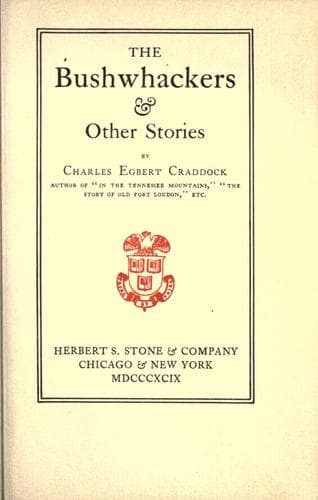
The bushwhackers & other storiesCraddock, Charles Egbert
General
The bushwhackers & other stories
Craddock, Charles Egbert
Mountain life -- Fiction; Tennessee -- Social life and customs -- Fiction
He was a man of few words,--of few ideas; these were strictly military
and of an appreciated value. He was considered a promising young
officer, and was often detailed to important and hazardous duty. And
if he had naught to say at mess, and seldom could perceive a joke
unless of a phenomenal pertinence and brilliancy, broadly aflare so to
speak under his nose, he was yet a boon companion, and could hold his
own like a Scotchman when many a brighter man was under the table.
He had a certain stanch, unquestioning sense of duty and loyalty, and
manifested an unchangeable partisanship in his friendship, of a silent
and undemonstrative order, that caused his somewhat exaggerated view
of his own dignity to be respected, for it was intuitively felt that
his personal antagonism would be of the same tenacious, unreasoning,
requiting quality, and should not be needlessly roused. He was still
very young, although he had seen much service. He was tall and
stalwart; he had the large, raw-boned look which is usually considered
characteristic of the Scotch build, and was of great muscular strength,
but carrying not one ounce of superfluous flesh. Light-colored hair,
almost flaxen, indeed, with a strong tendency to curl in the shorter
locks that lay in tendrils on his forehead, clear, contemplative blue
eyes, a fixed look of strength, of reserves of unfailing firmness about
the well-cut lips, a good brick-red flush acquired from many and many
a day of marching in the wind, and the rain, and the sun--this is the
impression one may take from his portrait. He could be as noisy and
boisterously gay as the other young officers, but somehow his hilarity
was of a physical sort, as of the sheer joy of living, and moving, and
being so strong. One might wonder what impressions he received in the
long term of his service in Canada and the Colonies--these strange
new lands so alien to all his earlier experience. One might doubt if
he saw how fair of face was this most lovely of regions, the Cherokee
country; if the primeval forests, the splendid tangles of blooming
rhododendron, the crystal-clear, rock-bound rivers were asserted in
his consciousness otherwise than as the technical “obstacle” for troops
on the march. As to the imposing muster of limitless ranks of mountains
surrounding the little army on every side, they did not remind him of
the hills of Scotland, as the sheer sense of great heights and wild
ravines and flashing cataracts suggested reminiscences to the others.
“There is no gorse,” he remarked of these august ranges, with their
rich growths of gigantic forest trees, as if from the beginning of the
earliest eras of dry land,--and the mess called him “Gorse” until the
incident was forgotten.
Public-domain text, read in full here on John Shaqi.
Reviews
Reviews
No reviews yet
Be the first to share your thoughts on this work.
Elsewhere in the archive
Join the Discussion
Join the discussion
Sign in to leave a comment or review.
Sign InorCreate an account